


Aerodrome and Velodrome Merge Into Aero: Why I'm Bullish, the Risks, and What the Data Shows


One token. Seven blockchains. A redesigned staking and liquidity model. Here's why I think Aero could become a major player in multichain DeFi—and what could prove me wrong.
Research updated: October 25, 2026 | DADS DeFi Space
I've spent a lot of time farming liquidity on Base, and Aerodrome has been one of the protocols I've followed closely.
So when Aerodrome and Velodrome announced they were merging into one decentralized exchange called Aero, I was interested.
Not just because of the token.
Not because somebody was advertising a ridiculous APY.
But because this merger could fundamentally change how liquidity, trading fees, and token incentives work across multiple blockchains.
On October 22, 2026, Aero officially launched across seven chains. The protocol replaced its old weekly voting system with a new staking and reward allocation model, introduced cross-chain trading infrastructure, and redesigned how liquidity providers earn.
And what happened to the token?
It sold off.
By October 25, the new AERO token was trading around $0.68, down roughly 15–20% from its launch-period pricing.
Yet I'm still bullish on the long-term potential.
Here's where it gets interesting: I'm bullish on the technology and business model, but the early numbers don't fully support the bull case yet.
Approximately 94.5% of Aero's trailing 30-day revenue was still coming from Base. The protocol's new incentive system was just getting started, and its seven-chain expansion had only a few days of operating history.
I also have some skin in the game. I hold a small legacy locked AERO position that I haven't migrated yet, and I recently opened a cbBTC/AERO liquidity position on Base.
I'm not rushing to increase my exposure or migrate my lock simply because the upgrade is live.
As a dad, teacher, and DeFi investor, I've learned that understanding how a system works is more important than being first to click a button.
So let's break down what changed, why I'm bullish, what the numbers actually show, and the risks that could make me change my mind.
What Is Aero? Understanding the Aerodrome and Velodrome Merger
For roughly three years, Aerodrome and Velodrome operated as sister decentralized exchanges.
Aerodrome focused primarily on Base, Coinbase's Ethereum Layer 2 network.
Velodrome focused on Optimism and the broader Superchain ecosystem.
Both were developed by the team now known as Dromos Labs.
Their original model rewarded token holders who locked their assets and voted on which liquidity pools should receive token emissions.
That system helped both exchanges become significant liquidity and trading venues.
According to Aero's launch materials, Aerodrome handled approximately 58% of Base DEX trading volume in Q3 2026, while Velodrome handled approximately 60% of OP Mainnet's.
The combined platforms also reportedly distributed more than $580 million in lifetime exchange revenue to stakers.
Those are substantial historical figures, although they don't guarantee the new system will perform equally well.
On October 22, 2026, the two protocols combined into Aero, operating with one token and a unified incentive system.
The seven launch chains
Aero launched across:
Base
Ethereum
OP Mainnet
Arbitrum
Ink
Arc
Robinhood Chain
The idea is straightforward.
Instead of running separate liquidity incentive systems across individual networks, Aero wants to build a connected trading and liquidity ecosystem.
And that is the foundation of my bullish thesis.

Why I'm Bullish on Aero: Five Parts of My Investment Thesis
1. A proven model is expanding into a much larger market
Aerodrome and Velodrome already demonstrated that their liquidity incentive model could attract trading activity on Base and Optimism.
But those two chains represent only part of the broader decentralized exchange market.
According to Dromos Labs' prelaunch research, the seven target chains collectively processed approximately $120 billion in DEX volume during the 30 days ending October 14.
That represented nearly four times the trading volume available across Base and OP Mainnet alone.
That doesn't mean Aero automatically captures four times the revenue.
It means the potential market is significantly larger.
The challenge is whether the team can compete against established liquidity venues on Ethereum, Arbitrum, and the newer chains.
2. One token and cross-chain liquidity could reduce fragmentation
One of DeFi's biggest problems is fragmented liquidity.
A token might have a deep trading pool on Base, another pool on Arbitrum, and several smaller pools on Ethereum.
Liquidity providers divide their capital among them, while traders encounter different prices, slippage, and fees.
Aero's proposed solution is Metaswaps.
Metaswaps are designed to combine bridging, routing, and swapping into a single cross-chain transaction.
The goal is to let liquidity on one chain serve trading demand originating on another.
If this works efficiently and safely, fewer pools may be able to support a broader trading network.
That could improve capital efficiency.
However, it also introduces cross-chain execution and security risks that didn't exist in the same form under the old systems.
3. Stakers receive the protocol's pool revenue
Under the new design, Aero directs 100% of pool revenue to sAERO stakers.
That sounds attractive, but there's an important distinction:
Revenue sharing is not the same as guaranteed investment returns.
The amount a staker earns depends on the pools they support, the revenue those pools generate, the allocation of other stakers, and the applicable staking mechanics.
If trading activity declines, revenue can decline.
If more capital competes for the same revenue, individual returns can decline.
This is why I care about actual fees and trading activity more than advertised staking yields.
A protocol can issue tokens to create an attractive APY.
It cannot manufacture sustainable trading demand simply by printing rewards.
4. Aero is trying to make token emissions more efficient
This might be the most important change in the entire merger.
The old system distributed a scheduled quantity of tokens every week.
The new AER Engine attempts to link incentives to expected pool revenue.
Instead of allocating a fixed number of tokens regardless of economic activity, the protocol calculates reward values in dollars and applies limits known as Gauge Caps.
The target is approximately 1.2 times projected pool revenue.
For example:
Pool metric | Illustrative amount |
Expected trading revenue | $10,000 |
Reward target at 1.2x | $12,000 |
Reward value above the cap | Not issued |
Actual token issuance | Depends on token price and claims |
Illustrative calculation, not an actual Aero pool.
The key innovation is that rewards prevented by the cap are not minted.
In theory, this reduces unnecessary dilution.
Aero's own estimates suggest effective annual issuance could fall into approximately the 8–12% range under certain conditions, compared with roughly 11% under the prior system. The protocol also describes a 20% annual hard cap.
These are projections, not established postlaunch results.
And they create an important question:
Can Aero maintain enough incentives to attract liquidity while issuing fewer tokens?
That's something the next several months should help answer.
5. Robinhood Chain and tokenized assets could become major growth catalysts
This is one of the areas I'm watching most closely.
Aero isn't expanding only into traditional crypto trading pairs.
Its strategy also includes tokenized stocks, bitcoin-dollar markets, and on-chain foreign exchange.
According to Dromos Labs' launch research, Aerodrome's share of tokenized-stock DEX trading on Ethereum and its Layer 2 networks reportedly grew from approximately 2% in early September to 57% by October 10.
Those figures are company-reported and need continued independent validation.
But they point toward an interesting opportunity.
Robinhood Chain is designed around tokenized financial assets, and Aero now has a presence there.
As someone already researching tokenized stocks and liquidity farming on Robinhood Chain, I see a potential connection between traditional markets and DeFi infrastructure.
If tokenized stocks attract more users and trading volume, decentralized exchanges capable of supporting that activity may benefit.
But Robinhood Chain becoming successful does not automatically mean Aero wins.
Aero still needs to capture meaningful trading fees and retain liquidity against competitors.

What Actually Changed? Aerodrome vs. the New Aero
The merger isn't simply a rebrand.
Several important mechanisms have changed.
Feature | Old Aerodrome / Velodrome | New Aero |
Governance and rewards | Weekly ve(3,3) voting | Continuous Predictive Allocation |
Staking | veAERO / veVELO locks | sAERO staking NFTs |
Revenue | Epoch-based claims | Revenue streams to allocating stakers |
Emissions | Scheduled weekly issuance | Revenue-linked AER Engine |
Pool incentives | Bribes and voting incentives | Liquidity and Launch Payments |
Cross-chain trading | Separate ecosystems | Metaswaps |
Liquidity technology | Slipstream concentrated liquidity | Slipstream V3 |
Automation | Legacy relays | Autopilot |
Network coverage | Primarily separate ecosystems | Seven-chain launch |
Understanding sAERO
Under the old system, users locked AERO or VELO and received voting positions.
These positions could participate in weekly voting to direct incentives.
Under Aero, users receive sAERO, represented by a transferable staking NFT.
Instead of voting once per week, stakers allocate their influence toward pools expected to generate future revenue.
There is a reported 47-hour cooldown between allocation changes for an individual position.
The new system also removes the old rebase mechanism.
An important caution: the exact maximum staking duration, maturity rules, early-exit conditions, and several other staking details were not fully resolved in my October 25 research.
These details matter before anyone migrates a long-term lock.
Predictive Allocation: rewarding tomorrow's trading activity
The concept is that stakers allocate rewards toward pools they expect to generate revenue next, rather than simply responding to last week's results.
Aero tested this approach using historical pool data.
Its modeling suggested that a shorter predictive signal, combined with gauge caps, could improve reward allocation accuracy compared with the old weekly system.
In one company-reported backtest, allocation accuracy increased from 48% under the older signal to approximately 70% with the revised approach and caps.
That's encouraging.
But backtests aren't live market results.
Real traders change behavior, market conditions shift, and liquidity can move quickly.
The new mechanism still has to prove itself.
Slipstream V3 and dynamic fees
Aero also introduced improvements to its concentrated-liquidity infrastructure.
Dynamic fees can increase during volatile conditions and decrease during calmer periods.
For liquidity providers, that matters because volatility can generate both trading revenue and losses from changing asset prices.
Aero reported that its WETH/USDC pool averaged approximately 3.9 basis points in calmer periods and 8.3 basis points during volatile periods in one prelaunch study.
The volatile periods represented about 15% of volume but produced 25% of fees.
That's an interesting result, although the comparison is protocol-reported and covers a limited sample.
Higher trading fees may help compensate liquidity providers for volatility.
They do not eliminate impermanent loss or guarantee positive net returns.
AERO Rewards or Trading Fees? The Decision Liquidity Providers Need to Understand
This is where the new system becomes especially important for yield farmers.
Aero liquidity providers can choose between different reward arrangements.
LP approach | What you earn | Important trade-off |
Staked, AERO-earning LP | AERO token incentives | Trading fees flow to sAERO allocators |
Unstaked, fee-earning LP | Trading fees | An unstaked fee may apply |
Out-of-range concentrated LP | Generally no active-tick AERO rewards | Capital remains exposed to asset price changes |
Early withdrawal from a minimum-stake period | Potential forfeiture of unvested rewards | Rewards may never be minted |
At launch, the reported promotional unstaked fee was 5% on Base, OP Mainnet, Ink, and Arc, and 0% on Ethereum, Arbitrum, and Robinhood Chain.
Those rates can change
Why this matters for yield farmers
Let's say a liquidity pool advertises a high AERO reward APR.
That number alone tells you very little about the quality of the position
I want to know:
What assets am I holding?
How correlated are they?
How much trading volume does the pool generate?
Am I earning token incentives or actual trading fees?
How much exposure do I have to AERO's price?
What happens when my position leaves its active range?
Are there minimum-staking requirements or withdrawal penalties?
A pool paying 100% APR in incentives can still lose money if the underlying assets decline enough.
A pool paying a lower fee-based APR may deliver a better net result depending on the assets, entry price, trading activity, and risk.
Pair first. Range second. Incentives third.
That is the order I prefer when evaluating concentrated liquidity.
My Own Aero Positions: Why I Haven't Migrated My Locked AERO Yet
I currently have two areas of exposure to Aero.
First, I hold a small legacy veAERO lock.
Second, I recently opened a cbBTC/AERO liquidity position on Base.
I want to be transparent about both because they create a bullish bias in my analysis.
My unmigrated veAERO position
I haven't upgraded my legacy lock to sAERO yet.
And I'm comfortable waiting.
The migration is irreversible, and according to the launch documentation there is no general deadline for self-custody holders to upgrade.
Before migrating, I want to verify that all final-epoch rewards and rebases have been claimed, that active votes have been reset, and that I fully understand the new staking terms.
I also want to decide whether to allocate manually or experiment with Autopilot.
My preference is to learn the mechanics with a small position before automating anything.
A few days of missed revenue on a small lock are less important to me than making an irreversible mistake.
I plan to document the upgrade process in a follow-up video.
My cbBTC/AERO liquidity position
This position introduces a different set of considerations.
I have exposure to both Coinbase Wrapped Bitcoin and AERO.
That means I'm not simply earning yield from two stable assets.
If AERO declines significantly relative to cbBTC, my LP can accumulate more AERO while losing value relative to simply holding the original assets.
If I choose AERO incentives, I also add reward-token exposure.
So I'm evaluating the position based on the complete result—not just the displayed APR.
My primary considerations are range management, reward structure, minimum-stake requirements, token-price exposure, and net profitability.
The big lesson is simple:
Earning more AERO is not necessarily the same thing as earning more dollars.
[IMAGE PLACEMENT 3 — Personal portfolio screenshot]
Suggested visual: Your actual cbBTC/AERO position dashboard, with wallet identifiers and sensitive details hidden. Annotate the pair, active range, reward type, and risk exposure. Do not add unverified profit figures.
Aero's First Four Days: What the Numbers Actually Show
Now let's look at the data.
This is where I want to separate my personal conviction from what the protocol has actually demonstrated.
The following figures are historical snapshots from October 24–25, 2026.
Metric | Reported value | Source |
Total value locked | ~$367 million | DefiLlama |
24-hour DEX volume | ~$522.14 million | DefiLlama |
24-hour revenue | ~$173,822 | DefiLlama |
Seven-day revenue | ~$1.51 million | DefiLlama |
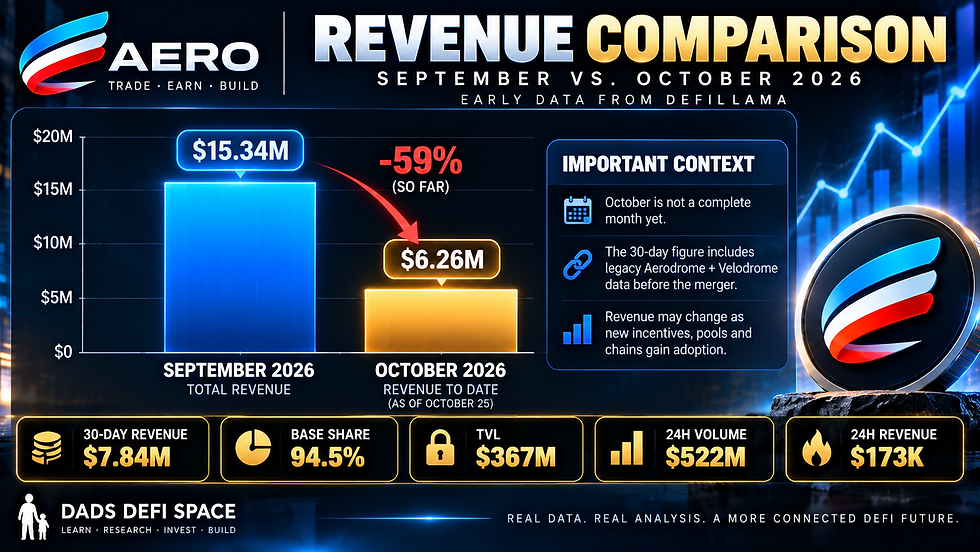
30-day revenue | ~$7.84 million | DefiLlama |
Base share of 30-day revenue | ~94.5% | DefiLlama |
October revenue to date | ~$6.26 million | DefiLlama |
September revenue | ~$15.34 million | DefiLlama |
Staked share | 44.51% | Aero dashboard |
AERO token price | ~$0.68 | CoinGecko |
Fully diluted valuation | ~$1.45 billion | CoinGecko |
These figures require some context.
The 30-day revenue figure includes activity from the legacy systems before the merger. It should not be treated as 30 days of revenue generated exclusively by the new Aero protocol.
DefiLlama and Aero's own dashboard also reported different volume and TVL figures because of differences in coverage, methodology, and time windows.
For example, Aero's dashboard showed approximately $344 million in TVL compared with roughly $367 million from DefiLlama. That is why I prefer to track the same source consistently over time instead of switching between whichever number looks better.

Base still dominates revenue
This is the biggest weakness in the early bull case.
Although Aero operates across seven chains, Base still produced approximately 94.5% of trailing 30-day revenue.
That means the new multichain strategy has not yet demonstrated broad revenue diversification.
However, there was one encouraging development.
Robinhood Chain reportedly generated approximately $35.26 million in 24-hour DEX volume, ranking second behind Base in the October 25 snapshot.
That's worth monitoring.
But volume alone isn't enough.
I want to see whether that trading activity produces meaningful and sustainable fees.
Emissions versus revenue
Another important metric is the relationship between incentive issuance and actual protocol revenue.
On the October 25 snapshot, DefiLlama showed approximately $223,765 in daily incentive value against roughly $173,822 in daily revenue.
That works out to about 1.29 times revenue.
It's relatively close to the protocol's approximate 1.2x reward target, but it is not proof that the new system has achieved its intended long-term economics.
The figures also need to be compared on a consistent accounting basis.
One day is a starting point.
Two or three months will tell us much more.
Why the staked share dropped
Before launch, approximately 51.1% of supply was reported as staked.
By the October 25 snapshot, that figure was approximately 44.5%.
At first glance, that might look like a major loss of confidence.
But the transition from veAERO and veVELO to sAERO changes how staking is counted.
Legacy locks that haven't upgraded are not counted as new sAERO positions.
The dashboard reportedly showed the new staked share climbing from around 24% on launch morning to more than 44% within several days.
That suggests migration progress is a major explanation for the decline.
It doesn't prove every missing holder will return.
The Bear Case: What Could Go Wrong With Aero?
A bullish investment thesis is only useful if you're willing to examine what could break it.
And Aero has meaningful risks.
Multichain competition
Aero's success on Base doesn't guarantee success on Ethereum or Arbitrum.
Those markets already have established exchanges, deep liquidity, and sophisticated liquidity providers.
Winning trading volume on new chains may require significant incentives.
Revenue weakness
October's reported revenue was tracking below September's.
Part of that may reflect the transition from legacy bribes to the new Liquidity and Launch Payments system.
But it could also reflect weaker trading conditions or lower incentive demand.
I need more data before assuming the decline is temporary.
Token dilution and incentive economics
Even a smarter issuance model still creates new tokens.
If emissions exceed the economic value generated by the protocol for a prolonged period, token holders may face dilution without corresponding growth.
The dollar-denominated cap is promising, but it must work through different market conditions.
Staking lockups and unclear terms
Some of the most important sAERO staking mechanics still required confirmation in my research, including maximum duration, maturity handling, and certain transfer or exit conditions.
I wouldn't recommend anyone migrate an irreversible position without reading the current official documentation.
Smart contract, bridge, and phishing risk
Seven-chain infrastructure increases the number of components that must operate securely.
Cross-chain execution adds complexity.
And front-end security matters just as much as contract security when users are signing transactions.
Aerodrome previously experienced a domain-related security incident in November 2025, and a fraudulent Aero upgrade website was identified around the October 2026 launch.
The lesson is not that every upgrade is unsafe.
It's that you should never rush a wallet approval because someone tells you a migration is urgent.
Concentrated liquidity risk
For LPs, token volatility, range exposure, adverse selection, and impermanent loss remain real.
The new reward system doesn't change those fundamentals.
How to Migrate Legacy AERO or VELO Safely
There are two different migration paths: liquid tokens and locked positions.
Liquid AERO and VELO
The published conversion ratios are:
Legacy token | New AERO received |
1 AERO | 1 AERO |
1 VELO | 0.044 AERO |
100 VELO | 4.4 AERO |
Self-custody balances do not automatically convert.
The documented process uses the legacy protocol interfaces and delivers new AERO on Base.
The migration is irreversible, and there is no general self-custody upgrade deadline in the launch documentation.
Coinbase separately announced automatic conversions for November 2–4, 2026, with related trading and transfer restrictions. Users should verify the current exchange notice before acting.
Locked veAERO or veVELO
The migration requires additional care.
Before upgrading a locked position:
Verify the current official migration instructions.
Make sure you control the wallet that owns the staking NFT.
Claim all eligible final-epoch rewards and rebases.
Reset any active votes as required.
Review the new staking duration and exit terms.
Confirm gas and cross-chain messaging requirements.
Verify the destination and resulting sAERO position before making further allocations.
Unclaimed legacy rewards may become unrecoverable after migration.
The resulting sAERO NFT has a new ID, and remaining lock time is carried over under the published rounding rules.
Security warning: Use official documentation and saved bookmarks. Never trust unsolicited migration links, direct messages, or requests for seed phrases.
Official project resources identified in the source research include:
Verify these destinations independently before connecting a wallet.
Inside My Research Notebook: Seven Metrics I'm Tracking Over the Next 60 Days
This is how I plan to judge whether the Aero merger is actually working.
Metric | Bullish confirmation | Warning sign |
Non-Base revenue | Sustained growth above ~10–15% share | Falls toward ~5% |
Revenue versus emissions | Incentives remain economically disciplined | Emissions substantially exceed revenue for two months |
Liquidity/Launch Payments | Payments recover as new incentives gain adoption | Payments remain weak |
sAERO staking | Staked share recovers above 50% | Migration stalls in the low 40s |
Robinhood Chain | Volume and fees both grow | Volume rises without meaningful fees |
Security | No material incidents | Contract, bridge, or front-end compromise |
Integrations | Third-party liquidity tools support new pools | Prolonged integration delays |
These are research thresholds, not automatic buy or sell signals.
What would make me less bullish?
Three developments would materially weaken my thesis.
First, revenue remains concentrated on Base. If the new chains fail to generate a meaningful share of revenue after several months, the multichain expansion is not delivering the economic diversification I expect.
Second, emissions consistently outrun revenue. If the new incentive engine cannot control dilution relative to the activity it supports, a major part of the redesign loses its appeal.
Third, a serious security failure occurs. An exploit or cross-chain failure could damage confidence and liquidity regardless of how attractive the tokenomics look.
I also want to see third-party liquidity management integrations return, including tools that help LPs manage concentrated positions.
Aero can have impressive technology and still fail to create attractive investment outcomes.
That's why I track the business, not just the token chart.
Upcoming Aero Catalysts and Dates to Watch
Timing | Event | Research significance |
October 31, 2026 | Reported Lisk withdrawal deadline | Legacy user action required |
November 2–4, 2026 | Announced Coinbase conversion window | Exchange migration and transfer restrictions |
November 2026 | First complete calendar month after launch | Better revenue and emissions comparison |
Early December 2026 | Review November's complete data | First major thesis checkpoint |
Ongoing | Metaswaps, fee upgrades, Autopilot, and integrations | Evidence of execution beyond launch |
Planned features and future timelines may change.
For me, the most important catalyst isn't another announcement.
It's seeing the new chains generate real revenue.
Final Thoughts: Why I'm Still Bullish on Aero
I'm bullish on Aero because I believe the team has taken a model that worked on Base and Optimism and given it a much larger opportunity.
One token.
Seven chains.
A more adaptive incentive system.
Cross-chain liquidity.
Potential exposure to growing tokenized-asset markets.
Those are meaningful changes.
But a bigger market doesn't guarantee a bigger business.
The early data shows that Aero still depends heavily on Base. Revenue has weakened compared with September, and the new reward allocation system hasn't had enough time to prove itself.
That doesn't invalidate the thesis.
It tells me what needs to happen next.
I'll continue monitoring the revenue numbers, managing my existing exposure, and learning the new staking mechanics before migrating my locked position.
And if the numbers stop supporting my thesis, I'll adjust it.
Because in DeFi, conviction should come from evidence—not from how much of a token you already own.
Process over prediction. Survive first, compound second.
Learn DeFi With DADS DeFi Space
If you're learning about liquidity pools, staking, impermanent loss, and managing risk, I built DADS DeFi Space to help make those concepts easier to understand.
Start with my free DeFi course:
Join our free Telegram community to discuss DeFi research, liquidity farming, and the projects we're following:
You can also explore additional educational articles and portfolio experiments at:
Disclaimer
This article is for educational and informational purposes only and is not financial advice. Crypto and DeFi involve significant risks, including smart contract vulnerabilities, token volatility, liquidity losses, and potential loss of capital. I hold a small legacy veAERO position and a cbBTC/AERO liquidity position, which may influence my perspective. Always conduct your own research and make decisions based on your financial circumstances and risk tolerance. Some links may be affiliate or referral links that help support DADS DeFi Space at no additional cost to you.
Comments