


Crypto Investing Mindset: 5 Principles for Long-Term Success
- Kevin- DADS DeFi Space
- 17 hours ago
- 14 min read


Before learning how to use a crypto wallet, trade on an exchange, research a token, or deploy capital into decentralized finance, every investor should first build something more important: a sound investing mindset and a "real" plan.
Crypto gives investors access to extraordinary technology, global markets, decentralized financial tools, and potentially significant long-term opportunities. It also exposes them to extreme volatility, emotional decision-making, scams, platform failures, complicated risks, and relentless speculation.
That combination can make crypto one of the most exciting financial markets in the world—and one of the easiest places to make costly mistakes.
After participating in crypto through a complete market cycle, I have learned that the people who survive and succeed over time are not usually the people who correctly predict every market move. They are not necessarily the people posting the largest gains on social media, either.
The investors who last are the ones who build a process.
They know why they are investing, how much risk they can tolerate, where they will add capital, when they will reduce exposure, how they will protect their assets, and what would invalidate their original thesis.
The goal is not to eliminate every loss. That is impossible.
The goal is to build a framework that allows you to make thoughtful decisions before fear, greed, or excitement takes control.
This guide explains five foundational principles that can help you become a more disciplined crypto investor:
Follow a process instead of relying on predictions.
Protect your capital before trying to grow it.
Manage risk rather than pretending you can avoid it.
Use self-custody responsibly.
Make decisions with a long-term perspective.
These principles will not guarantee profits. Nothing can.
They can, however, help you avoid the mistakes that prevent many investors from staying in the market long enough to benefit from its long-term opportunities.
Why Your Crypto Investing Mindset Matters
Most beginners enter crypto asking similar questions:
Which cryptocurrency should I buy?
What token could produce the largest return?
Which liquidity pool has the highest APR?
Is Bitcoin about to rise?
Has the market reached its bottom?
How can I make money quickly?
Those questions are understandable, but they are not the most important questions.
Experienced investors learn to ask different ones:
How much capital could I lose?
Where is the yield actually coming from?
What risks am I accepting?
Is the return sustainable?
Who controls the protocol or platform?
What would invalidate my investment thesis?
Does this position fit the purpose of my portfolio?
Could I emotionally handle a significant market decline?
Am I investing based on research or reacting to FOMO?
The quality of your questions influences the quality of your decisions.
A strong crypto investing mindset helps you shift from chasing returns to understanding risk. It helps you stop reacting to every headline, price move, or social media post and begin operating from a prepared plan.
That change is one of the most important transitions an investor can make.
Principle 1: Follow a Process Instead of Making Predictions
One of the central ideas behind my investing philosophy is simple:
Process over prediction.
A prediction is an attempt to determine exactly what will happen next.
A process is a repeatable system for deciding how you will respond to different outcomes.
There is nothing wrong with developing a market thesis. Investors must analyze probabilities, study market structure, and form expectations. The problem begins when a prediction becomes a substitute for a plan.
Someone might predict that Ethereum will eventually reach $15,000.
That prediction may prove correct or incorrect, but it does not answer the practical questions an investor faces today:
At what price would you begin buying?
How large would your position be?
Would you buy all at once or gradually?
What would cause you to reduce your exposure?
How would Ethereum fit within your total portfolio?
How long are you prepared to hold?
What happens if Ethereum declines another 30% after you buy?
A process turns a broad opinion into a decision framework.
For example:
If Ethereum enters my predetermined accumulation zone, I will begin buying in stages. If market structure breaks below my invalidation level, I will reduce my exposure and reassess the thesis.
That statement does not attempt to predict every move.
It establishes conditions and actions.
What a Repeatable Crypto Process Can Include
A basic crypto investment process may define:
Your investment goals
Your time horizon
Your preferred assets
Your maximum portfolio allocation
Your buying zones
Your position-sizing rules
Your invalidation levels
Your profit-taking strategy
Your storage plan
Your rules for speculative positions
Your review schedule
The purpose of this process is not to make you inflexible.
Markets change, and your plan must allow you to adapt when new information appears. However, your major decisions should not be invented in the middle of a stressful market move.
The best time to decide how you will respond to volatility is before the volatility arrives.

Process Helps Reduce Emotional Decisions
Crypto markets can move quickly. Prices can rise or fall by double-digit percentages over short periods. Social media can make every move feel like the beginning of a life-changing opportunity or an irreversible disaster.
Without a process, investors are likely to:
Buy after prices have already surged
Sell after a sharp decline
Increase risk because other people appear to be making money
Abandon a long-term plan after one difficult week
Refuse to exit because they have become emotionally attached to a token
Change strategies repeatedly without collecting enough evidence
A process creates separation between the market and your emotions.
Instead of asking, “What do I feel like doing right now?” you can ask, “What does my plan require under these conditions?”
That is a much more useful question.
Principle 2: Protect Your Capital Before Trying to Grow It
Capital preservation means protecting the money you have already accumulated before focusing on how quickly you can increase it.
Think about risk management like wearing a seat belt.
You do not wear a seat belt because you expect to crash every time you drive. You wear it because a crash is possible, and the consequences of being unprepared could be severe.
Investment risk works the same way.
You do not build safeguards because you expect every trade, protocol, exchange, or token to fail. You build safeguards because failure is always possible.
A Personal Lesson From My First Crypto Cycle
During my first full crypto market cycle, I made substantial gains, particularly through assets such as Solana. At one point, my total gains were approximately 400%.
That sounds successful, but the final number did not tell the whole story.
Near the end of the cycle, I became more aggressive. Instead of protecting the gains I had already made, I moved profits into additional altcoins and yield-farming opportunities.
I was chasing more upside at the exact point when I should have been reducing risk.
When the market turned, I lost approximately 80% of those profits.
I did not lose everything, but I gave back most of the progress I had worked to build.
That experience changed how I think about investing.
Making money during a strong market is only part of the job. Keeping enough of those gains to participate in the next opportunity is what allows wealth to compound.
Why FOMO Damages Portfolios
Fear of missing out often appears after an asset has already performed well.
Prices are rising. Social media is filled with screenshots. Everyone appears confident. Investors begin believing that the current opportunity may be their final chance to participate.
That belief encourages people to:
Buy after large price increases
Increase position sizes
Abandon diversification
Enter unfamiliar protocols
Ignore valuation
Overlook smart-contract risk
Use leverage without a clear plan
Refuse to take profits
The market will continue creating opportunities.
You do not need to capture every move.
Missing part of a rally may feel frustrating, but frustration is usually cheaper than losing capital because you abandoned your process.
Capital Preservation Does Not Mean Avoiding All Risk
No investment strategy can remove risk completely.
Even holding cash involves inflation and opportunity-cost risk. Bitcoin, Ethereum, altcoins, stablecoins, exchanges, wallets, lending protocols, and liquidity pools all carry different forms of uncertainty.
Capital preservation means accepting risk deliberately rather than accidentally.
It means understanding what can go wrong and limiting the damage if it does.
That is not fear.
It is responsible participation.
Principle 3: Manage Risk Instead of Chasing Returns
Risk management is not the avoidance of risk.
It is the control of risk.
Crypto investors frequently focus on the potential reward first. They look at the projected return, token upside, APR, or price target before studying what they could lose.
A better process reverses that order.
Before entering a position, ask:
What are the major risks?
How much could I reasonably lose?
What conditions would cause me to exit?
Is the potential reward worth accepting those risks?
How does this position affect my entire portfolio?
Position Sizing
Position sizing determines how much capital you allocate to one asset, trade, protocol, or strategy.
Even strong research cannot eliminate uncertainty. A promising investment can still fail because of market conditions, execution problems, regulation, poor tokenomics, a security exploit, or an incorrect thesis.
Smaller position sizes reduce the damage one mistake can cause.
Your highest-conviction assets may justify larger allocations, while experimental positions should usually receive much smaller ones.
A speculative position should never be large enough to threaten your broader financial stability.
Portfolio Allocation
Allocation refers to how your total investment portfolio is distributed.
A thoughtful portfolio might separate capital into different categories, such as:
Long-term core holdings
Stablecoins or cash reserves
DeFi positions
Trading capital
Higher-risk altcoins
Experimental protocols
The exact percentages will depend on your financial situation, experience, goals, and risk tolerance.
The important part is giving each allocation a purpose.
Every position should answer a question:
What job is this capital supposed to perform?
A Bitcoin position may be part of a long-term accumulation strategy.
An Ethereum position may provide long-term exposure while also being used selectively in DeFi.
Stablecoins may provide liquidity and flexibility.
A small experimental position may help you learn how a new protocol works.
Without a defined purpose, a portfolio can easily become a collection of unrelated assets acquired through excitement.
Diversification
Diversification can reduce exposure to a single point of failure, but owning many tokens does not automatically create a diversified portfolio.
Twenty altcoins may all react to the same market conditions. Several DeFi protocols may depend on the same blockchain, stablecoin, bridge, oracle, or source of liquidity.
Real diversification requires understanding the underlying risks—not simply increasing the number of assets you own.
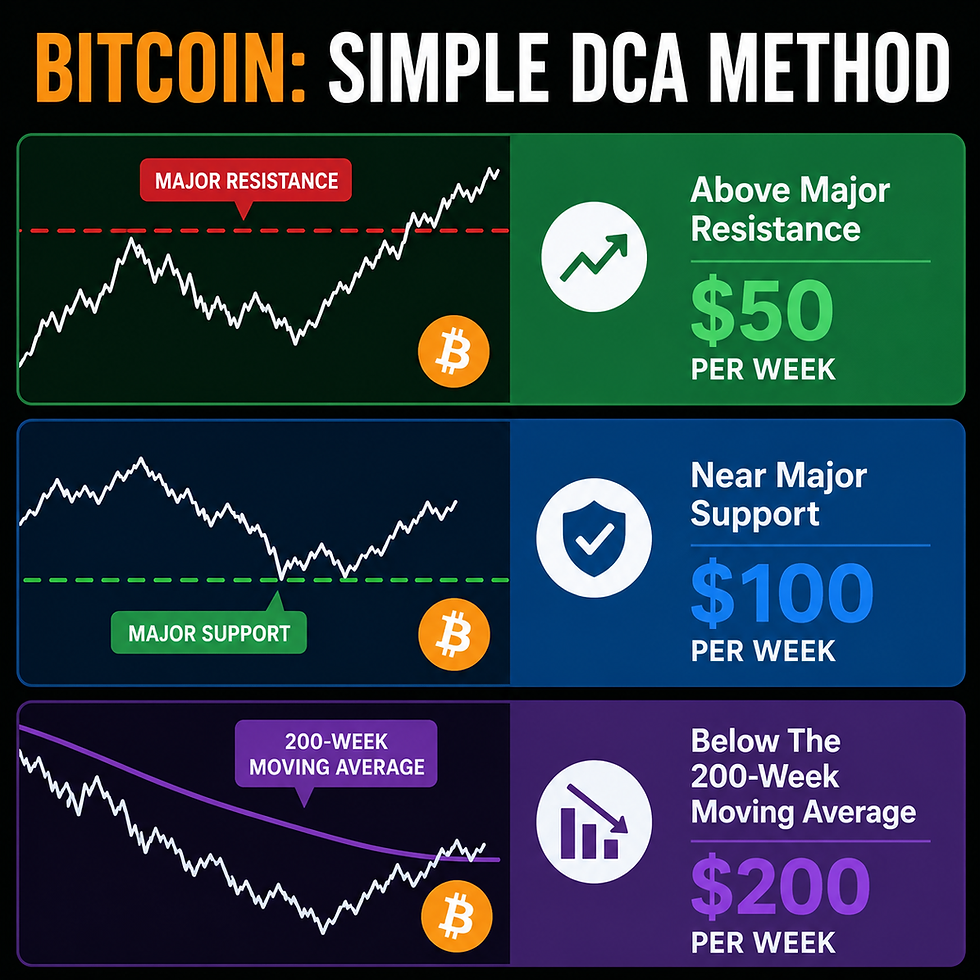
Buying and Selling in Stages (DCA for the Win)
Trying to identify the exact market bottom or top is extremely difficult.
A staged strategy allows you to make several smaller decisions instead of betting everything on one prediction.
You may:
Buy gradually as an asset enters your preferred range
Reserve capital in case the price moves lower
Take partial profits as price reaches predetermined targets
Reduce risk if your thesis weakens
Keep a smaller core position if your long-term conviction remains
This approach will not capture every dollar of upside.
That is acceptable.
A sustainable plan is more valuable than a perfect entry that only looks obvious in hindsight.
Start Small When Learning DeFi
When I begin using a new protocol, testing a new trade, or deploying a new DeFi position, I generally start with a small amount of money.
I do not allocate significant capital until I understand:
How deposits and withdrawals work
Which wallet approvals are required
Where the yield comes from
How fees are calculated
Whether liquidity is sufficient
What happens when market conditions change
What smart-contract risks exist
How the position fits my overall strategy
Starting small may cause you to miss some potential gains.
That is a reasonable price to pay for education.
A small position allows you to learn through experience without turning one misunderstanding into a major financial loss.
Principle 4: Take Responsibility for Crypto Self-Custody
One of the most powerful features of cryptocurrency is the ability to control your own assets.
With self-custody, you do not need permission from a bank or centralized platform to access or transfer your crypto. You hold the private keys that control the wallet.
This independence is one of the reasons Bitcoin and decentralized finance are important.
It also creates personal responsibility.
What “Not Your Keys, Not Your Crypto” Means
When your crypto is held on a centralized exchange, the exchange controls the private keys.
You may have an account balance, but you depend on the company to safeguard the assets and honor your withdrawal request.
The phrase “not your keys, not your crypto” is a reminder that an exchange balance is not the same as directly controlling a wallet.
Centralized platforms can experience:
Insolvency
Cyberattacks
Withdrawal restrictions
Regulatory intervention
Internal fraud
Operational failures
Bankruptcy
The previous crypto cycle included the collapse or failure of several major companies and platforms, including FTX, Celsius, BlockFi, and Voyager.
I personally had funds connected to several of those platforms. I was fortunate enough to withdraw most of my money, but approximately $500 remained trapped in bankruptcy proceedings.
That experience reinforced an important lesson:
An exchange can be useful, but it should not be treated as risk-free storage.
When Centralized Exchanges May Still Be Useful
Self-custody does not mean centralized exchanges have no purpose.
Investors may use exchanges for:
Buying or selling crypto
Converting between fiat currency and digital assets
Trading
Briefly holding funds before withdrawal
Accessing tools unavailable elsewhere
The key is recognizing the difference between using an exchange and depending on it for long-term custody.
I may use exchanges when needed, but I generally prefer to keep most long-term crypto in hardware wallets or properly secured self-custody wallets.
Self-Custody Creates New Risks
Self-custody transfers responsibility from a company to the individual.
That means you must protect:
Your seed phrase
Your private keys
Your hardware wallet
Your recovery process
Your wallet approvals
Your devices
Your passwords
Your exposure to scams and phishing
Losing a seed phrase, signing a malicious transaction, or sending funds to the wrong address may result in a permanent loss.
Self-custody is not automatically safer simply because it is decentralized.
It becomes safer when it is practiced responsibly.
Basic Self-Custody Habits
A strong self-custody process may include:
Never sharing your seed phrase
Never entering your recovery phrase into an unknown website
Storing backups securely and offline
Verifying URLs before connecting a wallet
Using a hardware wallet for larger holdings
Keeping experimental activity separate from long-term storage
Testing transfers with a small amount first
Reviewing token approvals
Avoiding unexpected links in direct messages
Maintaining a documented recovery plan
Self-custody is not only a technical skill.
It is part of risk management.
Principle 5: Think in Years, Not Days
Long-term investing means making decisions that could still make sense several years from now—not merely next week.
Crypto encourages short-term thinking because the market operates continuously. Prices move every hour. New tokens launch constantly. Narratives change quickly. Investors can monitor their portfolios at any time of day.
Constant access does not require constant action.
Some of the most productive decisions are simple:
Build knowledge
Accumulate gradually
Protect your capital
Take profits during strong markets
Maintain liquidity
Avoid overexposure
Learn from mistakes
Allow time to work
Patience is not passive.
Patience means waiting for conditions that fit your plan rather than forcing activity because the market is open.
Consistency Usually Beats Excitement
Exciting strategies attract attention.
Consistent strategies are more likely to survive.
A simple portfolio with clear rules may appear boring compared with aggressive trading, highly concentrated altcoin bets, or the newest yield opportunity.
Boring is not necessarily bad.
A complicated strategy that you cannot follow during stress is less useful than a simple process you can repeat for years.
One piece of advice my father used to give was:
Keep it simple.
That applies to crypto.
You do not need to use every blockchain, own every token, trade every market, or enter every DeFi protocol.
You need a strategy that matches your life, knowledge, available time, and tolerance for risk.
Emotional Control Is Part of Risk Management
Portfolio decisions are affected by more than charts and data.
Sleep, stress, physical health, family responsibilities, and mental fatigue can all influence judgment.
That is why I frequently talk about stepping away from the screen and “touching grass.”
Taking a break is not abandoning your portfolio.
Sometimes it is the most responsible decision you can make.
When stress is high, people become more likely to:
Chase losses
Trade impulsively
Increase leverage
Ignore their rules
Interpret neutral information emotionally
Become excessively fearful or greedy
A strong investment process should include rules for your own behavior.
For example:
Do not make major decisions while exhausted.
Step away after a significant loss.
Avoid increasing risk to recover money quickly.
Review the plan before entering a position.
Wait before reacting to dramatic headlines.
Keep investment capital separate from essential expenses.
Your mental state is part of your risk environment.
Ignoring it does not make it disappear.
Can You Handle a 30% Crypto Market Decline?
A useful way to evaluate your risk tolerance is to imagine that the market falls 30% tomorrow.
Ask yourself:
Would I still understand why I own my assets?
Would I be able to sleep?
Would I panic and sell everything?
Would I have cash available?
Would the decline interfere with essential expenses?
Would I be tempted to use leverage?
Would I follow my existing plan?
Would I still believe my position sizes were appropriate?
Your answers matter more than someone else’s portfolio recommendations.
A position that is reasonable for one investor may be completely inappropriate for another.
If a normal crypto drawdown would cause severe financial or emotional distress, the position may be too large.
Risk tolerance should not be measured by how confident you feel while prices are rising.
It is measured by how well you can follow your plan when the market moves against you.
Five Crypto Investing Principles to Remember
The central lessons of a strong crypto investing mindset can be summarized in five principles.
1. Process Over Prediction
Build rules for how you will act under different market conditions. Do not depend on correctly guessing every move.
2. Protect Your Capital
The first job of your portfolio is survival. Gains that are never protected cannot compound.
3. Manage Risk Deliberately
Use appropriate position sizing, allocation, diversification, staged entries, profit-taking rules, and invalidation levels.
4. Practice Responsible Self-Custody
Understand the difference between holding an exchange balance and controlling your own private keys. Protect your wallet and recovery information carefully.
5. Think Long Term
Make decisions that support your goals over several years. Consistency, patience, education, and discipline usually matter more than short-term excitement.
Questions Every Crypto Investor Should Answer
Before continuing deeper into crypto, take time to write down your answers to the following questions.
Why are you investing in crypto?
Are you trying to build long-term wealth, learn new technology, diversify your investments, generate income, trade actively, or participate in decentralized finance?
Your reason will shape your strategy.
What are your long-term goals?
Define what you want crypto to help you accomplish over the next three, five, or ten years.
A clear goal makes it easier to reject opportunities that do not serve your plan.
How much risk can you realistically accept?
Consider both your financial ability to absorb losses and your emotional ability to tolerate volatility.
These are not always the same.
What does success look like in five years?
Success does not have to mean reaching a specific portfolio value.
It may mean:
Owning more Bitcoin or Ethereum
Building a secure self-custody process
Developing a reliable investment system
Avoiding major losses
Creating a source of supplemental income
Understanding DeFi
Becoming less emotional during market volatility
Building enough knowledge to make independent decisions
Define success before the market defines it for you.
A Better Goal Than Finding the Next 100x Token
The crypto industry often encourages investors to believe that success depends on discovering one extraordinary opportunity.
That belief can lead to oversized positions, excessive speculation, and repeated exposure to unnecessary risk.
A better goal is to become the kind of investor who can participate in many opportunities over time.
That requires survival.
It requires protecting capital, continuing to learn, adapting when evidence changes, and building confidence through repeated experience.
You will not make every decision correctly.
Neither will I.
The goal is not perfection. The goal is to create a process strong enough that one mistake does not end your journey.
Learning compounds just like capital.
Every cycle can improve your judgment. Every mistake can strengthen your framework. Every well-managed position can increase your confidence.
That is how an investor builds something more valuable than a prediction:
A repeatable process.
Continue Building Your Crypto and DeFi Foundation
This lesson is part of the broader DADS DeFi Space educational system designed to help beginners build knowledge, confidence, and a responsible process before taking larger risks.
If you are still learning about wallets, self-custody, decentralized exchanges, liquidity pools, yield farming, and crypto risk management, start with the free DADS DeFi Space course:
Free DeFi Course:https://www.dadsdefispace.org/challenges
The purpose of the course is not to tell you what to buy. It is to help you understand the tools, risks, and decision-making frameworks needed to navigate crypto and DeFi more independently. We are currently in thbe process of a massive revison to the free course, other stand along programs will be available shortly.
You can also join the free DADS DeFi Space Telegram community for ongoing educational updates, market observations, and portfolio discussions:
Free Telegram Community:https://t.me/DADSDefiSpace
Disclaimer
This article is for educational and informational purposes only and is not financial advice. Crypto and DeFi involve risk, including the possible loss of capital. Always conduct your own research and make decisions based on your financial situation, goals, knowledge, and personal risk tolerance. Some links may be affiliate or referral links that help support DADS DeFi Space at no additional cost to you.

Comments