$INDEX on Robinhood Chain: Stock Rewards, Microcap Momentum and My MAXFi LP Experiment


Robinhood Chain is becoming much more interesting to me than simply a place for tokenized stocks.
I've spent a lot of time recently exploring the tokenized-stock side of the ecosystem, especially through liquidity pools on MAXFi. But as Robinhood Chain grows, another part of the ecosystem is starting to emerge:
The memes, microcaps and community-built projects.
These are not assets I approach the same way I approach Bitcoin, Ethereum or even established altcoins.
They're speculative.
They're volatile.
Many won't survive.
99.9% don't
But new ecosystems are also where some of the strangest and most interesting experiments tend to happen.
So I'm starting a new research series looking at Robinhood Chain microcaps that catch my attention
I'm not looking for reasons to tell people to buy them.
I'm looking at four basic things:
Value. Momentum. Technical structure. Community.
And when one of these projects has a MAXFi liquidity pool, there's a fifth question:
Would I farm it?
One of the first projects that caught my attention is $INDEX.
After researching it, following the community, looking at the chart and putting some of my own money into a small WETH/INDEX MAXFi experiment, I think this is a great place to start.
What Is $INDEX?
$INDEX is an independent community project built on Robinhood Chain.
First, an important clarification:
$INDEX is not an official Robinhood token or a Robinhood-issued investment product.
It's a separate project using Robinhood Chain infrastructure.
What caught my attention is what happens when people trade it.
According to the project's published mechanism, $INDEX trades include a 3% ETH tax. Those fees are used to purchase a basket of tokenized stocks available through Robinhood Chain.
Qualifying $INDEX holders then receive distributions of those tokenized stocks.
The project describes an 18-stock basket, with distributions occurring automatically approximately every 15 minutes.
In simple terms:
People trade $INDEX → fees are generated → tokenized stocks are purchased → stock tokens are distributed to holders.
That is a pretty unusual experiment.
We've had reflection tokens in crypto for years. But instead of simply distributing more of the same speculative token, $INDEX is attempting to convert some of the economic activity around the token into tokenized traditional assets.
That doesn't automatically make $INDEX valuable.
It doesn't make it safe.
But it made me stop and research these one.
The Manager: Taking the Idea Another Step
The ecosystem around $INDEX is already starting to expand.
One of the newer developments I've been watching is The Manager.
The basic idea is to do something more useful with all those individual stock-token distributions.
Instead of letting small amounts of different tokenized stocks accumulate in a wallet, The Manager is being developed around different strategies that can convert those distributions toward a selected objective.
That includes strategies centered around assets such as INDEX, USDG and tokenized NVIDIA exposure.
That potentially changes the loop from:
Trade INDEX → receive stocks
into something closer to:
Trade INDEX → receive stock distributions → automatically redirect those distributions toward a chosen strategy.
I find that interesting because it starts giving the ecosystem another layer beyond the token itself.
But it's also important not to get ahead of reality.
This is still developing infrastructure. I'm treating The Manager as an emerging catalyst worth watching, not as proven sustainable yield.
That's going to be a recurring theme throughout this series:
Interesting doesn't automatically mean proven.
How Big Is $INDEX?
This is still a microcap.
During my August 8 research, different data sources put the $INDEX market capitalization somewhere around $9 million to $12.5 million, depending on the venue and price source.
Approximately 980.56 million INDEX were reported as circulating from a maximum supply of 1 billion.
Roughly 19.44 million INDEX had been sent to the burn address.
The research also identified approximately 12,000 holders.
And trading volume has been substantial relative to the project's size.
That's encouraging.
But there's an important lesson here.
Market cap is not liquidity.
A token showing a $10 million market cap doesn't mean there is $10 million sitting there waiting for everyone who wants to sell.
That's especially important with microcaps.
Liquidity around $INDEX has been fragmented across multiple pools. Different venues have even shown meaningful differences in price.
That's one of the biggest things I'm watching.
Because when we're talking about a token this small, liquidity matters almost as much as market cap.
The Community Is Part of the Investment Story
Community matters with microcaps.
A lot.
I'm not going to evaluate a $5 million meme the same way I'd evaluate Apple stock.
There may not be earnings.
There may not be years of financial statements.
Sometimes the community, narrative and network effects are a major part of what you're evaluating.
With $INDEX, approximately 12,000 holders this early caught my attention.
The project also has something many microcaps struggle to develop:
A story people can explain.
Trade the token.
Trading generates fees.
Fees buy tokenized stocks.
Holders receive those stock tokens.
That's relatively easy to understand.
Now I want to know whether the community surrounding that story is durable.
Are holder numbers continuing to grow?
Are people creating content?
Is development continuing?
Does liquidity deepen?
Does the community remain active after a 40%, 50% or 70% correction? So far yes.
That's where you find out whether you have a community or simply a crowd chasing momentum.
For now, I'd describe $INDEX as having:
Strong early community momentum, but not enough history to know how durable that community will become, but this is an interestuing one Im farming (small amounts) and watching
The Momentum Has Been Wild
There's no other way to describe it.
$INDEX has already experienced some enormous moves.
My research identified individual periods where the token reportedly moved approximately +150%, +157% and even +500% during 24-hour windows.
It reached a reported all-time high around:
$0.01438 on August 6, 2026.
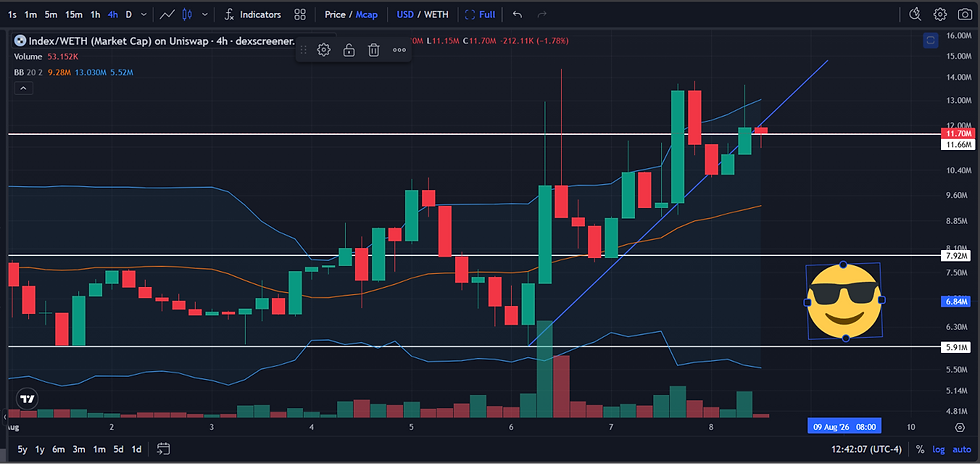
And then it experienced a significant pullback.
That's microcap crypto.
When someone sees +500%, the natural reaction is to think about how much money could have been made. this is why I used a almost 200% range. Earn fees as long as possible and Ill be one of the few on their other side if price spikes. Getting all the majority of the fees generated.
My reaction is a little different.
I immediately start thinking about what happens when the people sitting on those gains decide to take profits.
Because volatility works in both directions.