


LP Fees vs Impermanent Loss: My Real Portfolio Scorecard

One thing I teach my economics students is that revenue and profit are two very different things.
Think about a lemonade stand. You might sell $50 worth of lemonade, but if you spent $60 buying supplies, you didn't actually make any money.
The same basic principle applies to DeFi yield farming.
I've been farming liquidity pools for several years now, across multiple chains, and one of the biggest lessons I've learned is that earning fees doesn't necessarily mean you're making money.
You can have a liquidity pool generating some pretty impressive APRs while the underlying assets are losing value faster than the fees are coming in.
And I've experienced both sides of that.
That's why I wanted to take a closer look at LP fees versus impermanent loss, using my actual portfolios rather than hypothetical examples.
We're going to look at three of my DeFi portfolios:
MaxFi on Robinhood Chain
MaxFi on Base
Orca on Solana
Some positions have performed pretty well. Others haven't. And a few have reminded me why chasing APR alone is usually a bad idea.
My goal here isn't to show off returns. It's to help explain how I evaluate these positions, what I'm learning, and how I'm adjusting my strategy.
Because at the end of the day, it's not just about how much yield you're earning. It's about how much of that yield you're actually keeping.
DADS SCORECARD

What Is Impermanent Loss (and Why Concentrated Liquidity Makes It Louder)?
Before getting into the portfolios, let's cover one of the most misunderstood parts of liquidity providing: impermanent loss.
When you provide liquidity to a pool, you're typically depositing two different tokens.
As the prices of those tokens move relative to one another, the pool automatically adjusts the amounts you're holding.
Essentially, you're selling some of the asset that's increasing in relative value and accumulating more of the asset that's decreasing.
That's not necessarily a bad thing. In fact, depending on your strategy, it can be exactly what you want.
But there's a trade-off.
Impermanent loss is the difference between the value of your LP position and what those same tokens would have been worth if you had simply held them.
For a traditional 50/50 liquidity pool, here's approximately how that works:
Price change of one token relative to the other | Impermanent loss vs. holding |
+25% | -0.6% |
+50% | -2.0% |
+100% (2x) | -5.7% |
+400% (5x) | -25.5% |
These examples assume a standard constant-product pool and exclude fees.
Now, where things get a little more interesting is with concentrated liquidity.
On platforms like Uniswap, Orca Whirlpools, and MaxFi, you can concentrate your liquidity within a specific price range.
This allows you to potentially earn more trading fees with less capital.
Sounds great, right?
Well, there's another side to that equation.
The tighter your range, the faster your token composition changes as the price moves through it.
And if the price moves completely outside your range, your position generally ends up holding 100% of one token and stops earning trading fees until the price returns to your range or the liquidity is repositioned.
This is one reason I spend so much time looking at correlated pairs, price ranges, and rebalancing strategies instead of just chasing the highest APR.
The fees matter. But so does what you're accumulating along the way.
LP Fees vs Impermanent Loss: How Do Fees Offset the Damage?
This is where I think a lot of liquidity providers get into trouble.
They open a position, see a high APR, watch the fees accumulate, and assume everything is going great.
I've done it myself.
But here's the question I've been focusing on more lately:
Are the fees I'm earning actually making up for the losses or underperformance in the position?
I like to look at a simple fee coverage calculation.
Fee coverage ratio = fees earned ÷ measured loss
The important part is defining what loss you're measuring.
If you're comparing against simply holding the same tokens, you're measuring how much the fees offset your LP's underperformance relative to holding.
If you're comparing against your original dollar investment, you're measuring how much fees offset a decline in position value.
Those are two different measurements, and I think both are useful.
Here's how I interpret the ratio:
Above 1.0: Fees have covered the measured loss over that period.
Around 1.0: Fees have roughly offset the loss.
Below 1.0: Fees haven't been enough to cover the loss.
Of course, if there isn't a measured loss, this particular ratio isn't necessary. You can simply evaluate your net return.
Here's a practical example.
Let's say I'm earning $1.66 per day in LP fees.
That sounds pretty good, especially on a relatively small position.
But if the position is losing $10 per day in value, those fees aren't keeping up.
Now, some of that decline might simply be the market falling. That's why I also compare against holding the underlying assets.
A high APR doesn't automatically make a good investment.
And in my experience, some of the highest APR opportunities come with the most volatility.
That volatility can work in your favor when trading volume is high and prices stay within your range.
But when the underlying token starts falling hard, those fees can disappear pretty quickly compared with the losses.
This is why my approach has increasingly become:
PAIR FIRST → APR SECOND.
I want to understand the assets I'm farming before I get excited about the yield.
LP vs Holding: How I Benchmark My Portfolio
One of my longer-term investing goals is to accumulate more Bitcoin and Ethereum.
I still hold other assets, and I certainly take some speculative positions, but BTC and ETH remain important parts of my overall strategy.
So when I'm evaluating my DeFi portfolios, I don't just look at their dollar values.
I also want to know whether I'm accumulating more of the assets I actually want to own.
For example, if my portfolio increases 5% in dollars but Ethereum increases 15% during that same period, did my LP strategy really outperform simply holding ETH?
Not necessarily.
That doesn't automatically mean the strategy failed. Maybe I was intentionally reducing volatility, accumulating another asset, or generating cash flow.
But it's something I want to measure.
I generally look at three things:
True lifetime P&L: What is my portfolio actually worth compared with the capital I've invested, including fees I've collected and accounting for withdrawals?
Performance versus holding: Would I have been better off simply holding the underlying tokens, ETH, BTC, or SOL?
Capital movements: Am I separating deposits, withdrawals, and collected fees from actual investment returns?
That third point is especially important.
For example, one of my Base portfolio snapshots initially appeared to show a 15.5% decline.
But when I went back through the numbers, most of that difference came from capital I had intentionally withdrawn.
After accounting for those withdrawals, the actual decline was closer to 4.8%.
That's a pretty big difference.
And it's exactly why I'm working on improving my portfolio tracking.
I want to know what's actually happening, not just what a dashboard happens to display.
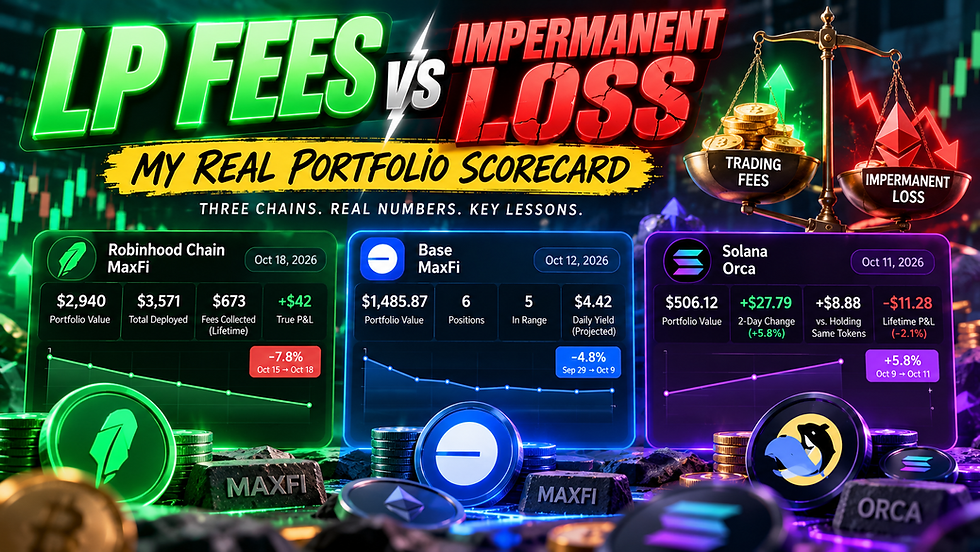
My LP Portfolio Scorecard: Real Receipts From Three Chains
Now let's look at the actual numbers.
These are historical snapshots from my portfolios, not live balances. I'm using them to show how different LP strategies have performed under different market conditions.
Robinhood Chain (MaxFi), Snapshot October 18, 2026
At the time of this snapshot, my Robinhood Chain MaxFi portfolio looked like this:
Portfolio value: Approximately $2,940 across 18 positions
Total deployed capital: Approximately $3,571
Fees collected: Approximately $673
True lifetime P&L: Roughly +$42

So technically, the portfolio was still profitable.
But barely.
And considering the amount of activity and yield farming involved, that's not exactly an impressive result.
What's even more interesting is what happened over just a few days.
Between October 15 and October 18, the portfolio declined approximately 7.8% in dollar value.
During that same period, Ethereum was down around 0.7%, while Bitcoin was actually up about 0.5%.
When I measured the portfolio in ETH terms, I went from roughly 1.31 ETH-equivalent to 1.22 ETH-equivalent.
That's not what I want to see.
Remember, one of my goals is to accumulate more ETH over time.
During that particular period, I would have been better off simply holding ETH.
Now, here's where the analysis gets interesting.
The biggest problems weren't necessarily coming from the tokenized-stock positions.
They were coming from some of the smaller, more speculative tokens I was farming.
Between October 17 and October 18:
INDEX: Down approximately 23%
BONER: Down approximately 17%
PONS: Down approximately 15%
Those percentages are based on prices implied by my own position snapshots.
Some of these positions had generated substantial fees, but the underlying token price declines were putting serious pressure on their performance.
At the same time, I had positions that were performing much better.
For example:
BONER: Approximately +$181 in true P&L
AMD: Approximately +$72
QQQ: Approximately +$68
One thing worth pointing out is that BONER could show positive lifetime performance while still experiencing a pretty significant short-term decline.
That's why I think looking at multiple time frames matters.
Meanwhile, positions like INDEX and PONS had generated fees covering only about a third of their measured value declines, or less.
And that brings me back to the main lesson.
Just because a pool is generating fees doesn't mean it's outperforming the market or even protecting your original capital.
I'm not necessarily giving up on these types of positions.
But I am becoming more selective about how much capital I allocate to them and how long I'm willing to hold them when the underlying thesis starts breaking down.
Base (MaxFi), Snapshot October 12, 2026
My Base portfolio has been a little different.
At the time of this snapshot:
Portfolio value: $1,485.87
Active positions: Six
Positions in range: Five
Projected daily yield: Approximately $4.42

Remember, projected yield is just that—a projection. It changes with trading volume, liquidity, and market conditions.
One thing I've been watching with this portfolio is how the LP positions behave during market pullbacks.
Between September 29 and October 9, the surviving positions declined approximately 4.8%.
Over that same period:
WETH declined around 7%
TAO declined around 9%
SOL declined around 8%
Now, this doesn't mean my LPs were hedged against losses.
They weren't.
But the combination of token conversions and earned fees helped cushion some of the decline compared with those individual assets.
This is one of the reasons I'm interested in farming correlated assets.
If I'm bullish on two assets over the longer term, I may be comfortable accumulating either one as their relative prices move.
That doesn't eliminate impermanent loss, and it certainly doesn't eliminate downside risk.
But it can make the strategy more consistent with what I'm trying to accomplish.
Of course, I still need to compare each LP against simply holding its exact starting token allocation. Comparing against individual assets only tells part of the story.
Solana (Orca), Snapshot October 11, 2026
I've also been spending more time experimenting with Orca liquidity pools on Solana.
And the results have been interesting.
From my October 9 baseline to October 11:
Portfolio change: +$27.79, or approximately +5.8%
Performance versus holding the exact same tokens: +$8.88
Lifetime P&L on current positions: -$11.28, or approximately -2.1%

Over that two-day period, the portfolio also outperformed simply holding SOL, BTC, or ETH.
But here's what stands out to me.
While the portfolio increased almost $28, only about $8.88 of that represented outperformance versus holding the same starting tokens.
That's much closer to the actual benefit I want to measure from providing liquidity.
And even with that short-term improvement, the current positions were still down slightly on a lifetime basis.
One of the biggest contributors was my SI/SOL pool.
At the time:
Position P&L: -$18.37
Fees earned: $14.41
Those fees were helping offset the losses, but they hadn't fully made up the difference.
And with smaller, more volatile tokens, things can change quickly.
A few good days of trading fees can be wiped out by one significant price move.
That's why I treat these positions differently from my core BTC and ETH accumulation strategies.
They can offer interesting opportunities, but they also deserve smaller allocations and closer attention.

What I'm Changing (and What I'd Do Differently)
After reviewing these portfolios, there are a few things I'm thinking about changing.
And I want to be clear: these are adjustments I'm considering for my own strategy, not recommendations for anyone else's portfolio.
First, I'm becoming more selective with smaller-token LPs.
I've had some pretty successful farms involving speculative assets.
But I've also watched high APR positions lose value faster than the fees could compensate.
INDEX and PONS are good examples of why I need to pay attention to the underlying token, not just the advertised yield.
If the token continues declining and the fees aren't making up the difference, I need to reconsider whether that position still makes sense.
Second, I want more of my portfolio aligned with my longer-term goals.
If I'm trying to accumulate BTC and ETH, I should have a meaningful portion of my liquidity strategies working toward that objective.
That doesn't mean eliminating speculative farms.
It means making sure they don't become the entire strategy.
Third, I'm paying closer attention to how rebalancing actually works.
On MaxFi, for example, rebalancing can reposition liquidity around the current market price.
But that doesn't magically reverse losses or convert a declining token back into ETH.
You're still exposed to the assets in the pool.
Understanding those mechanics is important before deciding how much capital to allocate.
Finally, I'm improving how I track performance.
I want to know which positions are generating real returns, which are underperforming simply holding, and which are accumulating assets I actually want.
And if the data shows that my current approach isn't working, I'm willing to adjust.
That's part of investing.
You develop a thesis, test it, measure the results, and make changes when necessary.
Process over prediction.
How to Track LP Performance Yourself
You don't need an expensive portfolio management system to start tracking this stuff.
A basic spreadsheet can get you a long way.
Here's what I'd recommend tracking:
Your initial deposit: Record how much you deposited, the number of tokens, and their dollar values.
Weekly portfolio snapshots: Track current position value, token balances, earned fees, collected fees, and whether the position is in range.
Fee coverage: Compare your fees against the losses or underperformance you're trying to offset.
Performance versus holding: Calculate what your original tokens would be worth if you had simply held them.
Your original investment thesis: Write down why you entered the position and whether that reason still makes sense.
Also, make sure you're accounting for additional deposits, withdrawals, rebalances, and transaction costs.
Otherwise, it's easy to mistake moving capital around for investment performance.
One thing I've learned is that the more positions you manage, the easier it becomes to lose track of what's actually happening.
That's especially true when you're farming across multiple chains and protocols.
It's one of the reasons I'm rebuilding parts of my own MaxFi portfolio tracker.
I want a clearer picture of lifetime performance, not just whatever the dashboard says today.
Key Takeaways
After reviewing these portfolios, here are the biggest lessons I keep coming back to.
Fees are not the same as profit. A position can generate substantial yield and still lose money.
Impermanent loss matters, but so does the underlying token price. They're related risks, but they aren't the same thing.
Concentrated liquidity can increase fee generation, but it also increases your exposure to price-range movements.
Compare your LP against simply holding. Otherwise, you may not know whether providing liquidity actually added value.
Know what you're trying to accumulate. For me, BTC and ETH remain important longer-term goals.
Track your true P&L. Deposits, withdrawals, collected fees, and changing token prices all need to be accounted for.
And probably the biggest lesson of all:
Don't let a high APR distract you from what the underlying investment is actually doing.
Risk & Reality Check
Liquidity providing can be a useful strategy, but there are some important risks to understand.
Impermanent loss: Your LP can underperform simply holding the same assets, especially when their relative prices move significantly.
Underlying token declines: Even if fees offset impermanent loss, both assets can still lose substantial dollar value.
Concentrated liquidity: Tighter ranges may generate higher fees while in range, but positions can become inactive when prices move outside those ranges.
Small-cap volatility: Speculative tokens can experience significant price declines in very short periods.
Smart-contract risk: DEXs, liquidity managers, and automated strategies can have vulnerabilities.
Liquidity and slippage: Thin markets can make entering or exiting positions more expensive.
Variable yields: APRs and projected daily earnings can change quickly.
Rebalancing risk: Automated repositioning doesn't guarantee better performance or eliminate exposure to declining assets.
And remember, a few days of positive or negative performance doesn't necessarily tell you how a strategy will perform over several months.
That's why I prefer to evaluate these positions over time rather than making decisions based on one good or bad day.
Frequently Asked Questions
Do LP fees cover impermanent loss?
Sometimes they do, and sometimes they don't.
It depends on how much trading activity the pool generates, how much liquidity is competing for those fees, and how the underlying token prices move.
I've had positions where fees more than compensated for impermanent loss and others where the fees didn't come close.
The important thing is to compare the value of your LP, including earned fees, against what you would have had by simply holding the same starting tokens.
Is liquidity providing worth it compared to just holding?
It can be, depending on the assets, market conditions, and your goals.
Liquidity pools can perform well when there's consistent trading volume and prices remain within your selected range.
But when one token makes a significant move relative to the other, simply holding may outperform. For me, the question isn't just whether the LP made money.
It's whether providing liquidity improved the outcome compared with the alternative.
Why does concentrated liquidity increase impermanent loss?
Concentrated liquidity puts your capital to work within a narrower price range.
That can increase your share of trading fees while your position is active.
But it also means your token balances change more rapidly as the relative price moves through that range.
If the price moves outside your range, the position generally ends up holding only one token and stops earning trading fees until it becomes active again.
How do I calculate impermanent loss?
For a traditional 50/50 constant-product liquidity pool, the formula is:
IL = 2√d ÷ (1 + d) − 1
Here, d represents the price ratio change between the two assets.
For example, if one token doubles in value relative to the other, the LP experiences approximately 5.7% impermanent loss compared with holding.
Concentrated liquidity requires a more specific calculation based on your selected range and the price movement.
Personally, I think one of the most useful approaches is simply comparing your LP's current value with what your original tokens would be worth if you had held them.
What happens when my LP position goes out of range?
When a concentrated liquidity position moves outside its selected range, it generally stops earning trading fees.
The position also becomes concentrated entirely in one of the two assets.
Depending on which direction the relative price moved, you may end up holding more of the token that declined in relative value or the other token after it appreciated.
At that point, you can wait for the price to return, manually reposition your liquidity, or use an automated strategy if the platform supports it.
Just remember that rebalancing doesn't eliminate the underlying market risk.
What is a good APR for a liquidity pool?
I don't think there's one universal answer.
I've seen some pretty attractive APRs on relatively stable or correlated pairs, and I've seen extremely high APRs on speculative tokens that subsequently lost substantial value.
Personally, I'd rather have a reasonable yield on assets I want to accumulate than chase an enormous APR on something I don't really want to hold.
That's why I keep coming back to the same principle:
PAIR FIRST → APR SECOND.
Keep Learning With DADS DeFi Space
If you're interested in DeFi, liquidity pools, yield farming, and building a better investment process, that's exactly what I'm documenting through DADS DeFi Space.
I'm actively managing portfolios across multiple chains, testing strategies with real capital, and sharing both the successes and the mistakes along the way.
The goal isn't to tell you what to buy or promise unrealistic returns.
It's to help you better understand how these strategies work so you can make more informed decisions.
Join the free DADS DeFi Space Telegram community:
That's where I share more frequent portfolio observations, market commentary, research, and conversations about the projects I'm following.
If you're newer to crypto and DeFi, you can also check out my free DeFi education course:
And for more portfolio reviews, LP experiments, and educational articles, visit:
I'll continue documenting these portfolios as the market changes, including the positions that don't work out the way I expected.
Because sometimes the biggest lessons come from the positions that don't perform.
Survive first. Compound second.
Disclaimer
This article is for educational and informational purposes only and is not financial advice. Crypto and DeFi involve significant risk, including loss of capital. The portfolio results discussed are historical snapshots of my personal positions and are not guarantees of future performance. Always do your own research and make decisions based on your own financial situation and risk tolerance.
I may personally hold positions in the assets and protocols discussed. Some links may be affiliate or referral links that help support DADS DeFi Space at no additional cost to you.

Comments