


My KRYSTAL AI Vault Is Finally Recovering — But the APR Is Telling a Different Story


This is Episode 7 of my KRYSTAL AI Agent-managed DeFi vault series, and this might be one of the most useful updates yet.
Not because the vault is suddenly perfect.
Not because I found some magical AI money printer.
And definitely not because the APR is going vertical.
Actually, the opposite is happening.
The vault is improving…
but the APR is coming down.
And that is exactly why this update is worth talking about.
Because in DeFi, most people are trained to chase the biggest number on the screen. If they see 100% APR, they get excited. If they see 20% APR, they think something is broken.
But that is not always how this game works.
Sometimes lower APR can actually be a sign that the strategy is becoming healthier, more stable, and less exposed to getting wrecked by volatility.
That is where my KRYSTAL AI vault is right now.
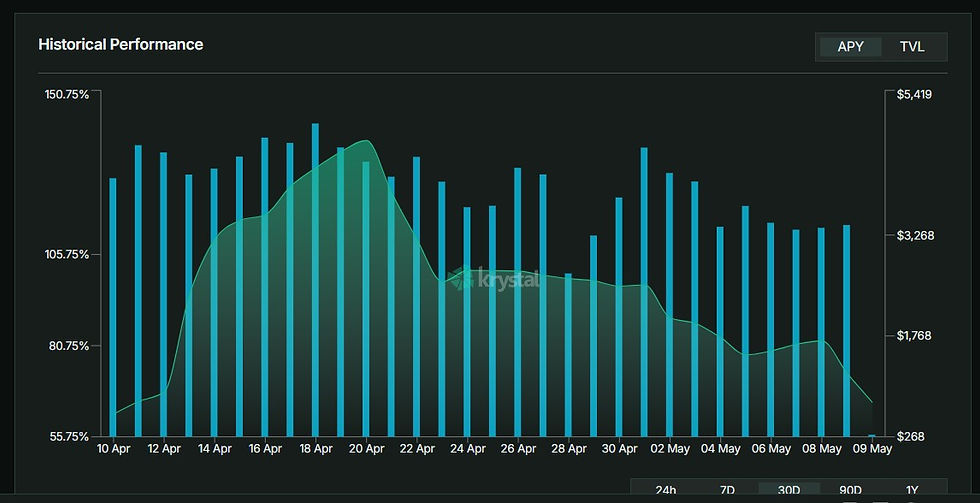
The vault is still negative overall. So let’s not throw a parade. But over the last seven days, the PnL improved, fees increased, TVL grew, and the main WETH/USDC position widened its range.
That matters.
This is not a victory lap.
This is a recovery update.
And honestly, that is a better teaching moment anyway.
Because DeFi is not about pretending every position is a win. It is about learning from the data, tightening the process, and making better decisions as the market gives you new information.
That is the whole point of this series.
Process over prediction.
The Big Lesson From Episode 7
The biggest lesson from this update is simple:
A vault can become healthier even while the APR drops.
That sounds weird at first, especially if you are used to judging DeFi positions by yield alone.
But let’s slow it down.
A high APR usually comes from one of a few things:
APR Driver | What It Can Mean |
High trading volume | Real fees may be flowing |
Tight liquidity range | More capital efficiency, but more range risk |
Token emissions | Yield may be temporary |
Higher-risk pair | More reward, but more downside |
Low liquidity | APR may look good but execution can be ugly |
So when APR falls, the first question should not be:
“Is this bad?”
The better question is:
Why did it fall?
In this case, the APR falling may be connected to a wider WETH/USDC range and changing pool dynamics. That means the position may be less aggressive, but also less fragile.
And right now, after the vault has already been through drawdown, that is not necessarily a bad trade-off.
I would rather see a more realistic, sustainable, in-range CORE position than chase some wild APR number that only works if the market behaves perfectly.
And let’s be honest.
Crypto rarely behaves perfectly.
7-Day Vault Performance Snapshot
Here is the clean performance update from the last seven days.
Metric | Last Check | Current | Change |
TVL | $440.76 | $469.79 | +$29.03 / +6.6% |
Total PnL | -$196.40 | -$166.81 | +$29.59 improvement |
Fees Generated | $139.46 | $148.78 | +$9.32 new fees |
24h Earnings | $2.27 | $0.98 | -$1.29 |
30d Earnings | $0 | $2.11 | +$2.11 |
Active Positions | 2 | 2 | No change |
The most important number here is not the APR.
It is the PnL improvement.
The vault moved from -$196.40 to -$166.81.
That is an improvement of $29.59 over the last seven days.
Now, is the vault profitable overall?
No.
It is still down.
But is it recovering?
Yes.
And that distinction matters.
A lot of people in DeFi only talk about wins. I think that is dangerous. The better lesson is showing how a vault behaves after it gets hit, how it recovers, and whether the strategy improves over time.
That is what I am watching here.
What Actually Improved This Week?
Here is the simple version of what improved.
Area | Update | My Read |
PnL | Improved by $29.59 | Good progress |
Fees | Increased by $9.32 | Fee engine still working |
TVL | Up 6.6% | Vault value improved |
WETH/USDC range | Widened to 28% (more capital appreciation) | More room for volatility |
Risk exposure | WETH/VVV appears reduced | Less aggressive posture |
APR | Dropped | Not automatically bad |

That last one is the big teaching point.
The APR dropped, but the vault got healthier in other ways.
That is why I do not want to judge this vault like a beginner staring at one number.
The better question is:
Is the overall system improving?
From this update, I would say yes.
Cautiously.
Not perfectly.
But yes.
The Main Position Now: WETH/USDC as the CORE Engine
The vault now appears to be leaning heavily into the WETH/USDC CORE position.
And honestly, I like that.
WETH/USDC is easier to understand than a random high-emission altcoin pair. It has real trading demand. It gives exposure to ETH while pairing against USDC. And it is a cleaner foundation for a vault that is trying to recover.
That does not mean it is risk-free.
There is still impermanent loss risk.
There is still range risk.
There is still execution risk.
But the risk is easier to understand.
And in DeFi, that is a big deal.
Here is the current WETH/USDC position.
Metric | Current Value |
Strategy ID | 79736123 |
Protocol | Aerodrome Concentrated |
Pool TVL | $15,146,702.99 |
LP Value | $316.97 |
PnL | +$4.47 |
ROI | 1.43% |
APR | 22.95% |
Status | IN_RANGE |
Price Range | 1982.319790 – 2519.992111 |
Range Width | 28% |
Current Pool Price | 2321.852892 |
Pending Fees | $1.60 |
Pool 7-Day APR Metric | 156.24% |
The position is in range.
It is positive.
It has pending fees.
And the range is wider than before.
That is not the sexiest update in the world, but it is a healthier one.
Sometimes in DeFi, boring is not bad.
Sometimes boring means the position is finally acting like a grown-up.
The RISK Position Looks Reduced — And That May Be a Good Thing
The previous WETH/VVV RISK position looks like it may have been closed, reduced, or replaced.
That is important.
Earlier in the vault series, the RISK side was where a lot of the higher APR potential lived. But it was also where more token risk lived.
That is the trade-off.
The RISK position can help a vault recover faster when it works.
But it can also make the drawdown worse when it does not.
Right now, the report suggests the vault is mainly centered around WETH/USDC, with some smaller idle balances sitting in tokens like:
Token | Likely Role |
VVV | Leftover risk token balance |
WETH | ETH exposure / dust |
cbBTC | Idle token balance |
AERO | Reward or leftover asset |
This looks less aggressive than before.
And for this stage of the vault, I am okay with that.
The vault is not in “go full degen” mode.
It is in “recover with structure” mode.
That is a much better place to be.
Why the Wider Range Matters
The WETH/USDC range widened from about 23% to 28%.
That might sound like a small detail, but in concentrated liquidity, it matters a lot.
Previous Range | Current Range | What Changed |
23% | 28% | More room for price movement |
A wider range usually means lower capital efficiency.
In plain English, that means the position may earn less APR because the liquidity is spread across a broader price area.
But the benefit is that the position has more room to stay active.
That is important because if price moves outside your range, the position can stop earning fees.
So yes, a narrower range may look better on the dashboard.
But if the market keeps moving around and knocking you out of range, that beautiful APR does not mean much.
This is where a lot of people get tricked.
They see a tight range with high APR and think:
“That is the better position.”
Not always.
The better position is the one that fits the market, the asset, the volatility, and your risk tolerance.
Right now, this wider WETH/USDC range looks like a more defensive adjustment.
And after the vault has already been through drawdown, I like that direction.
APR Dropped: Red Flag or Healthier Strategy?
The WETH/USDC APR dropped from around 45.20% to 22.95%.
That sounds bad at first.
But let’s put it in context.
Metric | Previous | Current | My Read |
WETH/USDC APR | 45.20% | 22.95% | Lower yield |
Range Width | 23% | 28% | More defensive |
Position Status | In range | In range | Still productive |
Position PnL | Positive | Positive | Still working |
Risk Profile | More concentrated | More flexible | Healthier for volatility |
This is why I keep telling people:
APR is not the scoreboard.
APR is a signal.
PnL is closer to the scoreboard.
And risk-adjusted performance is what actually matters.
Would I rather earn 45% APR in a tight range that can get knocked around?
Or 22.95% APR in a wider, cleaner, in-range position that helps the vault recover more steadily?
Right now, I would lean toward the second one.
Especially because this vault is still clawing back.
There is a time to be aggressive.
There is also a time to stop making the vault fight with one hand tied behind its back.
Fees Are Helping, But PnL Is Still the Real Scoreboard
The vault has now generated $148.78 in total fees.
That is up from $139.46 last week.
So the fee engine is still working.
But the total vault PnL is still -$166.81.
That tells us the full story.
Metric | Current Status |
Fees generated | Improving |
Current WETH/USDC position | Positive |
Overall vault PnL | Still negative |
Impermanent loss recovery | Improving but unfinished |
Strategy direction | More defensive and focused |
This is the part of DeFi people do not talk about enough.
You can earn fees and still be down.
You can have a productive LP and still be recovering from earlier mistakes.
You can have an AI agent doing useful work and still need to manage risk carefully.
That is why I do not want this article to sound like a hype piece.
This vault is improving.
But it is not fixed yet.
That is the honest read.
What the Transaction History Shows
The transaction history gives us another layer of information.
The screenshots show recent vault actions like increasing liquidity, rebalancing, adding liquidity, and decreasing liquidity.
That matters because the transaction log tells us what the vault actually did, not just what the dashboard says.
Timeframe | Action | Position / Pair | Why It Matters |
About 3 hours ago | Increase Liquidity | WETH / USDC | Added more capital to CORE |
1 day ago | Rebalance | WETH / VVV | Adjusted prior risk position |
4 days ago | Rebalance | WETH / VVV | Another risk-side adjustment |
Apr 30 | Add Liquidity | WETH / USDC | Expanded CORE exposure |
Apr 24 | Increase Liquidity | WETH / VVV | Added to prior risk position |
Apr 23 | Decrease Liquidity | WETH / USDC | Reduced or repositioned liquidity |
Apr 23 | Increase Liquidity | WETH / USDC | Redeployed liquidity |
This is one of the reasons I like using real vaults as case studies.
The dashboard tells one story.
The transaction history tells another.
If an AI agent is rebalancing constantly, I want to know that.
If it is increasing CORE exposure, I want to know that.
If it is still touching RISK positions, I want to know that too.
Because automation is not automatically smart.
The agent needs a good framework.
Otherwise, it can just create more churn.
And churn is one of the silent killers in DeFi.
The Idle Capital Problem
The agent report also mentioned around $4.35 in idle token balances.
Now, that is not a massive amount of money.
Nobody is losing sleep over four dollars and change.
But it still teaches a useful operational lesson.
In DeFi, idle capital is capital that is not fully working.
The report suggested consolidating small token balances into USDC and redeploying once the total reaches around $5 or more.
That makes sense.
Issue | Current Situation | Possible Action |
Idle balances | Around $4.35 | Consolidate into USDC |
Deployment threshold | $5+ | Redeploy into CORE |
Priority level | Low | Worth monitoring |
Main concern | Inefficiency | Avoid wasting gas/slippage on dust |
The key is not to overreact.
You do not want to spend too much effort or cost managing tiny dust balances.
But you also do not want the vault slowly filling up with leftovers that never get redeployed.
So the solution is simple:
Set a threshold.
Let the dust accumulate.
Then redeploy when it is actually worth doing.
Again, that is process.
Strengths
1. The Vault Is Recovering
The vault improved by $29.59 in total PnL over the last seven days.
That is the most important positive update.
Still down, but moving in the right direction.
2. Fees Are Still Growing
The vault generated another $9.32 in fees.
That means the strategy is still producing income.
The fee engine is alive.
3. TVL Increased
TVL moved from $440.76 to $469.79.
That is a 6.6% increase.
For a small vault, that is meaningful.
4. The CORE Position Is In Range
The WETH/USDC position is still active and productive.
That is exactly what I want from the CORE side.
5. The Range Is More Defensive
The move from a 23% range to a 28% range gives the position more breathing room.
That can help reduce fragility in a choppy market.
Weaknesses I’m Still Watching
Now let’s not pretend everything is perfect.
There are still issues.
1. The Vault Is Still Negative Overall
The vault is still sitting around -$166.81 in total PnL.
That matters.
It is recovering, but not recovered.
2. APR Is Lower
The main APR dropped to 22.95%.
Again, I do not think that is automatically bad. But it does mean the vault needs to prove the lower yield is worth the added stability.
3. Limited Diversification
The vault appears heavily centered around WETH/USDC right now.
That may be safer, but it is also less diversified.
Eventually, I would like to see the vault return to a cleaner 70/30 CORE/RISK structure, but only when the setup makes sense.
4. Idle Tokens Need Cleanup
The idle balances are small, but they are still worth monitoring.
A good vault should have a plan for dust, rewards, and redeployment.
5. 24-Hour Earnings Dropped
24-hour earnings fell from $2.27 to $0.98.
One day of lower earnings is not a major issue.
But if activity keeps dropping, the APR may continue to fade.
But I did withdraw from capital to establish a new Snuggle.Fi Position.
My Updated Vault Strategy Going Forward
Here is how I would think about the vault from here.
1. Keep WETH/USDC as the Foundation
Right now, WETH/USDC is the cleanest position.
It is in range, positive, and easier to manage.
That should remain the CORE of the vault unless conditions change.
2. Do Not Force a New RISK Position
The target framework is 70% CORE and 30% RISK.
But that does not mean I need to force a RISK position just to satisfy the model.
The RISK side has to earn its place.
If the setup is not there, patience is better.
3. Watch the APR, But Do Not Worship It
The APR dropping is worth tracking.
But I am not going to panic just because the number is lower.
If lower APR comes with better stability, wider range protection, and improving PnL, that may be a good trade-off.
4. Consolidate Idle Capital When It Makes Sense
Once idle balances reach a useful threshold, they can be converted and redeployed.
But I do not want the agent over-managing tiny amounts.
That creates unnecessary churn.
5. Stay Ready for the ETH $2,190 Trigger
The defensive ETH trigger still matters.
If ETH drops below $2,190, the vault should become more cautious.
That means:
Widen ranges
Reduce RISK exposure
Increase CORE allocation
Avoid unnecessary churn
Prioritize capital preservation
That is not a prediction.
That is a plan.
Big difference.
If you're looking to enhance your financial portfolio and generate passive income, consider exploring the exciting world of farming with KRYSTAL DEFI. This innovative platform offers a unique opportunity to earn yields that can significantly boost your earnings while you sit back and watch your investment grow.
Join the DADS DEFI SPACE KRYSTAL Vault Journey!
Don't miss out on this chance toput ypur idle coins to work and earm passive income on your crypto. Krystal , you can earn yield with us and take your first step towards financial freedom. With user-friendly features and robust security, KRYSTAL DEFI makes it easy for anyone to start earning.
🔗 Click here to visit the DADS DEFI SPACE Vault and start earning yield with us: https://defi.krystal.app?r=oLHq66gQB5Vq
Explore Our Other Vaults
If you're interested in diversifying your investments, check out our DADS USDC VAULT, which offers a reliable way to earn even more:
Additionally, you can also explore the AI AGENT VAULT for innovative strategies and higher yield potential:
Take action now and start your journey towards earning passive income with KRYSTAL DEFI!
The Bigger AI Agent Lesson
Episode 7 reinforces one of the biggest lessons from this entire series:
The AI agent does not replace the operator. It scales the operator’s process.
That is how I view this.
The AI can rebalance.
It can compound.
It can harvest.
It can follow rules.
It can manage things faster than I can manually.
But it still needs a smart framework.
If my rules are sloppy, the agent can execute sloppy rules.
If my risk management is weak, the agent can scale weak risk management.
If my framework improves, the agent becomes more useful.
That is what I think we are seeing in this update.
The vault is not perfect.
But the process is improving.
It is moving away from pure APR chasing and toward better risk-adjusted management.
And that is the exact direction I want to see.
FAQ Section
What is the KRYSTAL AI vault?
The KRYSTAL AI vault is an AI-managed DeFi vault experiment where automated rules help manage liquidity positions, rebalance ranges, harvest or compound fees, and deploy capital based on a strategy framework.
Is the vault profitable now?
Not overall. The vault improved from -$196.40 to -$166.81, but it is still negative. The important update is that the PnL is moving in the right direction.
Why did the APR drop?
The WETH/USDC APR dropped from around 45.20% to 22.95%. That may be due to wider range positioning, changing pool activity, or lower fee demand. A lower APR is not automatically bad if the position becomes more stable.
Why is WETH/USDC the CORE position?
WETH/USDC is easier to understand than many riskier token pairs. It has strong trading demand, cleaner liquidity, and gives exposure to ETH while pairing against USDC.
What happened to WETH/VVV?
The previous WETH/VVV RISK position appears to have been reduced, closed, or replaced. The vault now looks more centered around WETH/USDC with some small idle token balances remaining.
Why does range width matter?
Range width determines how much room price has to move while the LP position remains active. A narrower range can produce higher APR, but it is easier to go out of range. A wider range usually earns less but can be more stable.
What is impermanent loss?
Impermanent loss happens when the value of tokens inside a liquidity pool changes compared with simply holding those tokens. In concentrated liquidity, this risk can become more intense because capital is deployed inside a specific price range.
What is the ETH $2,190 trigger?
The ETH $2,190 trigger is a defensive rule. If ETH drops below that level, the strategy should become more cautious by widening ranges, reducing RISK exposure, and increasing CORE allocation.
Conclusion
Episode 7 of the KRYSTAL AI vault series is not about a perfect win.
It is about recovery after some major inital mistakes.
The vault improved its PnL by $29.59 over the last seven days. It generated another $9.32 in fees. TVL increased by 6.6%. The WETH/USDC CORE position is still in range, positive, and now using a wider structure.
That is progress.
But the vault is still negative overall.
APR is lower.
Idle capital still needs cleanup.
And the system still needs to prove it can recover without taking unnecessary risk.
That is the real lesson.
AI-managed DeFi can be powerful, but it is not magic.
The agent still needs rules.
The operator still needs judgment.
The strategy still needs risk control.
For me, this update is a step in the right direction.
Less hype.
More structure.
Less APR chasing.
More process.
And that is exactly how I want this vault to evolve.
Because in DeFi, the loudest number on the dashboard is not always the most important one.
Sometimes the best signal is not higher APR.
Sometimes the best signal is a better process.
DADS DeFi Space Community
If you want more real-world DeFi breakdowns like this, head over to DADSDeFiSpace.org and join the free Telegram.
I share practical crypto and DeFi education focused on process, risk management, and execution — not hype. This KRYSTAL AI vault series is part of that mission: testing strategies in public, learning from the data, and showing what actually happens when DeFi automation meets real market conditions.
Website: https://www.dadsdefispace.org
Free Telegram: https://t.me/DADSDefiSpace
Free Course: https://www.dadsdefispace.org/challenges
Educational only. Not financial advice. Manage your own risk.


Comments