


Tokenized Stocks Are Splitting Into Two Markets: What DeFi Investors Need to Know


Tokenized stocks are starting to look like one of the more interesting bridges between traditional finance and DeFi.
But I think investors need to understand something before treating every tokenized stock like the same asset:
A token tracking a stock is not necessarily the same thing as owning that stock.
And two tokens tracking the exact same company or ETF may carry very different risks.
That distinction becomes even more important if you're providing liquidity, yield farming, or using automated LP strategies around tokenized assets.
Two recent developments involving Nasdaq, Kraken's parent company Payward, Robinhood, and AMC highlight why.
The bigger lesson isn't about any one company.
It's about understanding what you actually own before putting capital into a tokenized-stock LP.
What Is a Tokenized Stock?
At the simplest level, a tokenized stock attempts to bring exposure to a traditional equity onto blockchain infrastructure.
That can potentially make equities more compatible with onchain markets and DeFi applications.
But the words "tokenized stock" can hide some major differences.
One token might provide economic exposure to the price of a stock through a third-party structure.
Another could be designed much more closely around the actual security, including stronger shareholder protections and connections to traditional market infrastructure.
Both might track the same ticker.
They aren't necessarily the same investment.
This leads to a principle I think DeFi investors should remember:
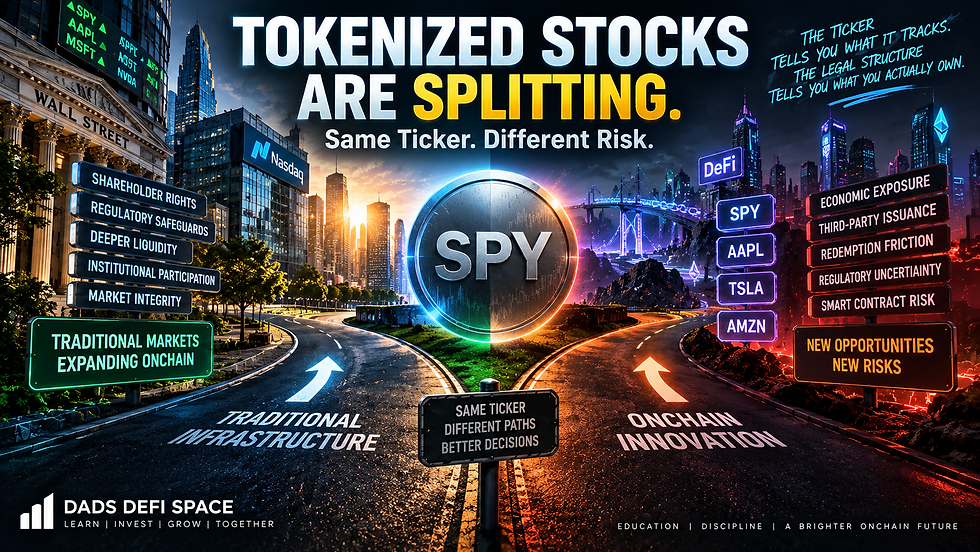
The ticker tells you what a token tracks. The legal structure tells you what you actually own.
Nasdaq Is Moving Toward Rights-Preserving Tokenized Equities
One of the biggest developments this week came from Nasdaq.
Nasdaq Ventures is investing $100 million in Payward, the parent company of Kraken.
The companies are targeting a Q2 2027 launch for Nasdaq Equity Tokens using Payward's xStocks infrastructure.
What's particularly interesting isn't simply that another large financial company is experimenting with tokenization.
Nasdaq says the planned tokens are intended to extend trading beyond conventional market hours while preserving shareholder rights, regulatory safeguards, and market integrity.
That's an important distinction.
Until now, much of the tokenized-stock market has involved third-party products designed primarily to provide economic exposure to an underlying stock.
Nasdaq's approach suggests another model may be developing:
tokenized equities more directly connected to the traditional financial infrastructure behind the security itself.
The Market Could Be Splitting Into Two Models
This is where things get interesting for DeFi.
We could eventually have two broad categories of tokenized equities.
Model 1: Rights-Preserving Tokenized Equities
These products could potentially have stronger connections to traditional securities infrastructure.
Important characteristics might include:
Shareholder rights
Regulatory protections
Stronger redemption mechanisms
Better primary-market arbitrage
More reliable price synchronization
Deeper institutional liquidity
Model 2: Third-Party Stock Wrappers
These products may primarily provide economic exposure to the price of an underlying stock.
Depending on their structure, investors may not receive the same shareholder rights they would receive from owning the actual security.
That doesn't automatically make a wrapper bad.
But it does make it different.
And different structures deserve different risk assessments.
The AMC and Robinhood Dispute Shows Why This Matters
AMC recently challenged a Robinhood-issued token connected to AMC shares.
According to the reporting and associated product information, the token provides economic exposure to AMC but is not itself the underlying AMC share.
The structure also does not provide ordinary shareholder rights.
AMC's CEO publicly objected to the product being created without AMC's participation.
Robinhood, meanwhile, maintains that its tokenized-stock products legitimately expand international access to equities.
I'm less interested in choosing a side in that argument than I am in what it teaches investors.

This turns something that can sound like a technical disclosure issue into a very practical question:
What happens to an LP if confidence in the wrapper itself changes?
1:1 Backed Doesn't Mean 1:1 Risk
This may be the most important lesson.
Even if a token is backed by an underlying asset, that does not eliminate every other layer of risk.
A tokenized equity can potentially face:
Issuer risk
Counterparty risk
Custody risk
Redemption friction
Regulatory uncertainty
Oracle or pricing risk
Liquidity risk
Market-maker withdrawal
Price divergence from the reference asset
That means two tokens tracking the same stock could trade at almost identical prices during normal conditions while carrying very different risks during market stress.
For an investor simply holding a small amount of a token, that distinction matters.
For a liquidity provider, it matters even more.
Why Tokenized-Stock Structure Matters for LPs
I've been spending a lot of time experimenting with tokenized-stock liquidity pools, particularly as these assets expand into DeFi.
One thing I've learned repeatedly is that APR is only one part of the position.
Pair selection matters.
Range matters.
Liquidity matters.
Volume matters.
Rebalance settings matter.
And now I think we need to add another category:
wrapper quality.
Imagine two tokenized versions of the same asset.
Both track the same underlying security.
Both are trading close to the reference price.
One has strong redemption infrastructure, deep market-maker participation, clear legal rights, and direct involvement from established financial institutions.
The other provides primarily economic exposure through a third-party structure.
Should those two assets receive the same LP position size?
I don't think they should automatically.
The Problem Automation Can't Fix
This also creates an interesting challenge for automated liquidity management.
Automation can potentially help manage things such as:
LP ranges
Rebalancing
Capital efficiency
Position monitoring
But automation cannot magically repair a structural problem with the underlying token.
If a tokenized-stock wrapper experiences legal uncertainty, redemption problems, disappearing liquidity, or sustained divergence from the reference asset, repeatedly rebalancing the position may actually make things worse.
The system could continue reallocating capital into an asset whose underlying risk has fundamentally changed.
That's why I think tokenized-stock automation eventually needs something beyond price and volatility data.
It may need a wrapper-quality risk framework.
A Tokenized Asset LP Risk Score
Here's the framework I'm starting to think about when evaluating tokenized assets for DeFi.
1. Underlying Exposure
What does the token actually track?
A stock?
ETF?
Commodity?
Index?
Something synthetic?
Understand the reference asset first.
2. Legal Ownership
What does owning the token actually give you?
Do you receive shareholder rights?
Or are you receiving economic exposure through another structure?
Those are not the same thing.
3. Issuer Involvement
Is the underlying company, exchange, or asset issuer involved?
Or was the token created independently by a third party?
Again, that doesn't automatically determine whether something is good or bad.
But it changes the risk profile.
4. Redemption Mechanism
How does the token reconnect to the underlying asset?
Strong redemption and arbitrage mechanisms can be extremely important for maintaining price alignment.
5. Price Synchronization
What keeps the token trading close to the reference stock?
If the token starts drifting away from the underlying asset, what mechanism pulls it back?
6. Liquidity Depth
How much real liquidity exists?
And perhaps more importantly:
Who provides that liquidity?
If a small number of market makers disappear, the risk profile could change quickly.
7. Regulatory and Jurisdiction Risk
Where is the token issued?
Which rules apply?
Who is allowed to trade it?
Those questions become especially important as tokenized equities expand across jurisdictions.
8. Automation Risk
Finally, what happens if something changes?
Should an automated LP strategy continue rebalancing?
Reduce exposure?
Pause?
Exit?
This could eventually become one of the most important safeguards for automated tokenized-asset liquidity.
What This Means for Tokenized SPY
This gets especially interesting when we start talking about something like tokenized SPY.
In the future, "tokenized SPY" may not describe one universally interchangeable asset.
There could potentially be multiple versions with different:
Issuers
Rights
Custodians
Redemption mechanisms
Liquidity
Regulatory structures
DeFi integrations
They could all track SPY.
They could all trade near the same price.
But that doesn't necessarily make them fungible from a risk perspective.
For LPs, that could mean different:
Position sizes
Range widths
Rebalance rules
Risk limits
Exit criteria
That's a much deeper question than simply asking which pool has the highest APR.
What I'm Watching Next
The Nasdaq development won't happen overnight.
The planned launch is currently targeted for 2027, and many implementation details still need to be demonstrated in practice.
But the direction matters.
Major financial institutions are moving beyond simply discussing tokenization and are beginning to put meaningful capital behind the infrastructure.
At the same time, disputes like AMC's challenge to Robinhood's stock tokens show that the definition of "tokenized stock" is still evolving.
I'm particularly interested in watching three things from here:
Redemption mechanisms.How easily can these tokens connect back to the underlying securities?
Liquidity and arbitrage.What keeps prices synchronized when markets become volatile?
DeFi integration.How should LP platforms and automated managers evaluate one tokenized wrapper against another?
Those questions could matter much more over time than whichever tokenized-stock pool happens to have the highest APR this week.
The Bigger Lesson for DeFi Investors
Tokenized assets could become an important part of onchain finance.
I'm excited about that possibility.
But bringing a ticker onchain doesn't eliminate the infrastructure underneath it.
Custody still matters.
Redemption still matters.
Liquidity still matters.
Legal rights still matter.
Counterparties still matter.
And risk management definitely still matters.
That's why I'm adding another question to my own DeFi process.
Instead of asking only:
"What does this token track?"
I'm also asking:
"What exactly do I own?"
Because in tokenized markets, those may be two very different questions.
Process over prediction. Pair first. APR second. Structure before both.
Continue Learning With DADS DeFi Space
I'm continuing to document tokenized-stock LPs, MAXFi strategies, concentrated liquidity, and the risks I'm finding as these markets develop.
If you'd like to follow my thinking between longer articles and videos, join the free DADS DeFi Space Telegram community:
And if you're still learning DeFi and liquidity pools, you can start with my free DeFi course:

Disclaimer
This article is for educational and informational purposes only and is not financial advice. Crypto, DeFi, tokenized assets, and concentrated-liquidity strategies involve risk, including possible loss of capital. Always do your own research and make decisions based on your own risk tolerance. Some links may be affiliate or referral links that help support DADS DeFi Space at no additional cost to you.

Comments