


Yield Hunter #1: My USDG/INTEL LP on MAXFi | A Deep Dive into Tokenized Stock Liquidity Pools on Robinhood Chain


Yield Hunter #1: Why I Built a USDG/INTEL Liquidity Pool on MAXFi
Over the past few weeks, I've been researching one of the most interesting developments I've seen in DeFi this year: tokenized stock liquidity pools on Robinhood Chain.
Instead of simply talking about the opportunity, I decided to do what I always try to do here at DADS DeFi Space—I built a real position and documented the experience.
This article accompanies the first episode of my new Yield Hunter series, where I'll be breaking down real liquidity pool positions, the reasoning behind each investment, and the lessons I learn along the way. Rather than chasing headlines or posting screenshots of high APRs, my goal is to help you understand why a position makes sense, where the yield comes from, and what risks deserve your attention before committing capital.
Why I Started the Yield Hunter Series
There is no shortage of content showing massive APR numbers.
What is often missing is context.
When someone sees 374% APR, it's easy to assume that number represents a guaranteed return or a sustainable long-term opportunity. In reality, that number only tells a small part of the story.
The purpose of the Yield Hunter series is to document real DeFi positions while teaching the framework I use to evaluate them. I want to show the decisions, the research, the risks, and the adjustments—not just the results.
Why I Chose the USDG/INTEL Pair
When MAXFi expanded onto Robinhood Chain, dozens of tokenized assets suddenly became available through concentrated liquidity pools.
Instead of chasing the most popular names, I chose Intel.
That decision wasn't based solely on recent price action. I looked at Intel's turnaround story, recent earnings, manufacturing developments, and the possibility that the market may still be undervaluing the company compared to its long-term potential.
Could I be wrong?
Absolutely.
That's why this position is part of an ongoing experiment rather than a prediction.
One of the principles I repeat often is:
Develop your own process—not your own hype.
My research may help generate ideas, but every investor should still perform their own due diligence before allocating capital.
Understanding the 374% APR
One of the biggest misconceptions surrounding new liquidity pools is assuming the displayed APR represents a future promise.
It doesn't.
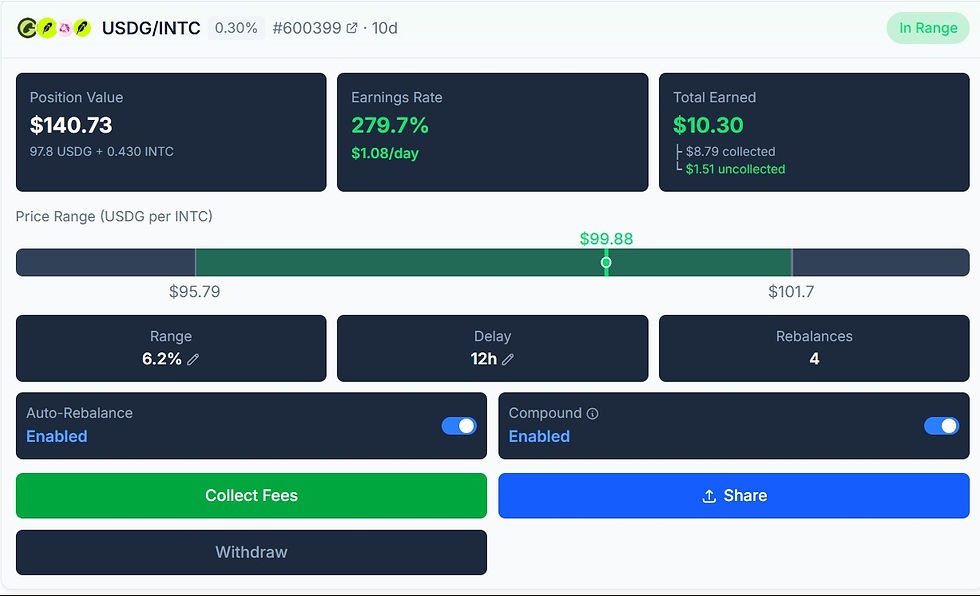
The 374% APR shown on my position was calculated based on the performance of the position since it was opened, during a period of unusually high trading activity and relatively low liquidity. Early participants often benefit from what many call a first-mover advantage, where a smaller pool of liquidity providers shares a larger amount of trading fees. As liquidity increases and trading conditions normalize, those APRs generally begin to decline.
In fact, I mention in the video that if I were opening the same position today, I would expect something much closer to 150% APR, which is still attractive but far more realistic than assuming 374% will continue indefinitely.
The lesson is simple:
Understand the source of the yield—not just the number.
Learn Alongside the Community
If you enjoy following real portfolio experiments like this one, consider joining the free DADS DeFi Space Telegram community.
That's where I share portfolio updates, market observations, and ongoing discussions that don't always make it into YouTube videos.
👉 Free Telegram: https://t.me/DADSDefiSpace
If you're completely new to Crypto or DeFi, I've also created a Free DeFi Course designed to help you build a solid foundation before exploring more advanced strategies like liquidity pools.
🎓 Free Course: https://www.dadsdefispace.org/challenges
My LP Settings
One of the reasons I wanted to publish this article is because most tutorials stop after explaining how to deploy liquidity.
Very few explain why they chose their settings.
For this position I selected:
A concentrated liquidity range around Intel's current trading zone
A 12-hour rebalance delay
MAXFi's Zero Swap Rebalancing technology
A relatively small allocation to begin testing the strategy
The objective wasn't to maximize APR.
It was to maximize learning while keeping risk appropriately sized.
The Four Biggest Risks
Every opportunity has trade-offs.
Here are the four primary risks I discuss in the video.
1. Impermanent Loss
If Intel experiences a strong directional move, the composition of the liquidity pool changes. That means your portfolio may end up holding more of the weaker-performing asset.
2. Smart Contract Risk
This strategy depends on multiple smart contracts working correctly.
Even well-audited protocols carry risk.
3. Tokenized Equity Risk
These are tokenized representations of stocks.
You are not purchasing traditional shares with voting rights. You're gaining price exposure through an on-chain representation backed by the underlying structure.
4. Business Risk
At the end of the day, Intel is still Intel.
If the company's turnaround fails, if earnings disappoint, or if broader market conditions change, the tokenized asset will reflect those developments.
No liquidity strategy can eliminate underlying business risk.
Why I'm Excited About Robinhood Chain
One of the reasons this experiment interests me so much is that it brings two worlds together.
Traditional equity investing.
And decentralized finance.
Instead of simply holding stocks inside a brokerage account, tokenized assets open the possibility of earning trading fees through liquidity provision while maintaining exposure to the underlying price movement.
It's still early.
There are still regulatory questions.
There are still technical risks.
But that's exactly why documenting these experiments publicly can be valuable for the community.
Looking Ahead: Yield Hunter #2
The next position I'll be covering is PLTR (Palantir).
It has a completely different investment thesis, different volatility profile, and a very different liquidity strategy than Intel.
I'm excited to compare the two and continue documenting the results over time.
The goal isn't to prove that every experiment works.
The goal is to become a better investor by studying each one honestly.
Continue Your DeFi Journey
If you found this article helpful, here are a few free resources to continue learning:
🎓 Free DeFi Course
Learn the fundamentals of wallets, DeFi, liquidity pools, and risk management.
💬 Join the Free Telegram Community
Follow my portfolio updates, ask questions, and connect with other investors learning DeFi together.
🚀 Explore MAXFi
If you're interested in experimenting with concentrated liquidity and Zero Swap Rebalancing, you can explore the platform I've been using for this series.
Disclosure: This is an affiliate link. If you choose to use it, it helps support DADS DeFi Space at no additional cost to you. I only recommend tools and platforms that I personally use and research.
Final Thoughts
One of the biggest mistakes I see in DeFi is people chasing returns before they understand the mechanics.
The purpose of Yield Hunter is to slow that process down.
To ask better questions.
To study opportunities with curiosity instead of emotion.
And to document the real investing journey—wins, losses, and everything in between.
Because in the long run, process beats prediction.
Disclaimer: This article is for educational and informational purposes only. It is not financial, legal, or tax advice and should not be considered a recommendation to buy, sell, or provide liquidity for any asset. DeFi involves significant risks, including smart contract vulnerabilities, impermanent loss, tokenized asset risks, liquidity constraints, market volatility, and the potential loss of capital. Always conduct your own research and make investment decisions based on your own financial situation and risk tolerance.

Comments