


DADS DeFi Space Crypto and DEFI Market Report | April 19, 2026

What a week for crypto, DeFi, and anybody trying to trade this market without losing their mind
What a week.
This was one of those weeks where crypto reminded everybody that it does not care about your confidence, your hot take, or your perfectly worded thread on X. It will humble you anyway.
I spent part of this week doing what a lot of traders probably did: adjusting on the fly, lowering risk, and realizing pretty quickly that this was not the kind of market to get cute in. The RAVE situation turned into a complete mess. Traders were getting liquidated left and right. Volatility was everywhere. Narratives were flipping by the hour. And after watching that play out, I did what I try to teach people to do in these conditions: I lowered the leverage, protected what profits I had left, and focused back on the bigger, more liquid names.
That is not exciting. But it is real.
Right now, my Aerodrome LP is basically narrowed down to cbBTC/USDC. It is still earning well for me, around 31% today, but I am watching it carefully because I have been around this market long enough to know that high emissions can make a setup look healthier than it really is. Sometimes the APR is real. Sometimes the APR is just makeup on a tired chart. That is why I am staying flexible and planning to rebalance after the market gives us more informatio
n.
I have also got about $1,000 on Aave that is indirectly affected by the rsETH mess. Nothing teaches protocol diversification faster than watching one exploit shake confidence across an entire DeFi stack. That is exactly why I do not keep all my eggs in one basket. One of the biggest mistakes people make in DeFi is assuming “good protocol” automatically means “safe.” It does not. Good protocol plus bad dependencies can still hurt you.
And then, because apparently crypto was not chaotic enough on its own, we also had another week of geopolitical whiplash. Trump headlines. Iran headlines. ceasefire talk. conflict talk. oil uncertainty. macro confusion. Markets hate uncertainty, and honestly, so do I. U.S. stocks pushed to fresh records last week, but under the surface the mood still looks headline-driven and fragile, especially with renewed Middle East tension keeping traders on edge.
That is the backdrop for this report.
So no, I am not coming into this week pretending I have perfect certainty. I am coming into it with a framework.
And the framework is simple: process over prediction.
This is not the kind of market where I want to force altcoin aggression, max leverage, or fake confidence. This is the kind of market where I want to read the structure honestly, respect the risk, earn yield where it makes sense, and wait for better spots instead of donating capital in the middle of the range.
Executive snapshot
My current bias is neutral, but hedge-biased. You know I'm sitting short.
That does not mean I am full bear. It does not mean I think the market has to implode tomorrow. It means I still think the risk-reward is uneven enough that I would rather stay disciplined than emotionally bullish.
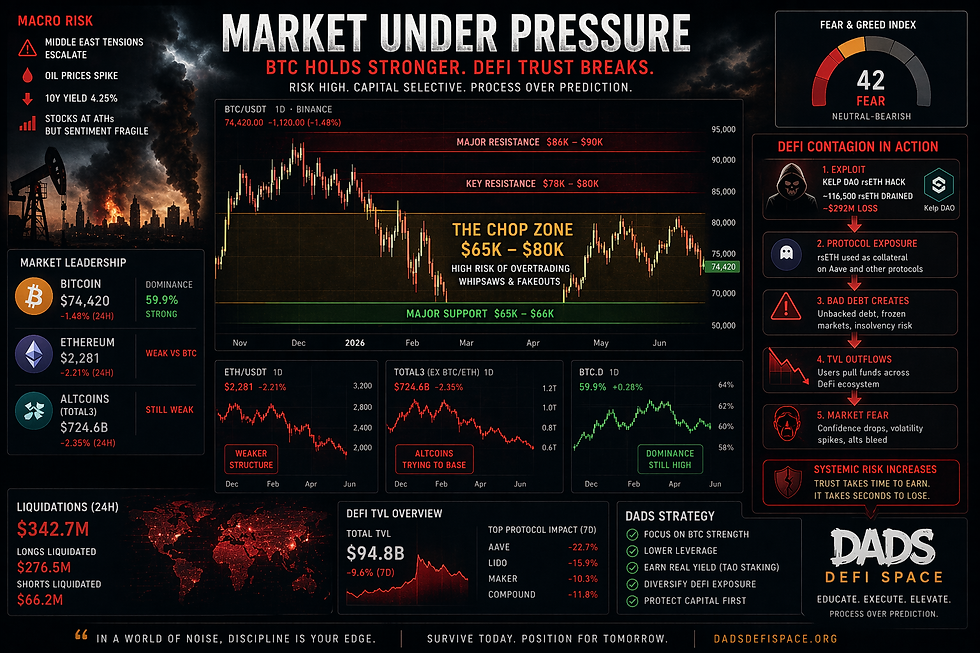
On the macro side, the setup is mixed. The S&P 500 and Nasdaq pushed to record highs week, while the U.S. 10-year Treasury yield softened toward 4.25%, which normally helps risk assets a bit. But that tailwind is competing with geopolitical noise, oil sensitivity, and a market that still looks mentally exhausted. And it sounds like the Strait of Hormuz is closed again.
Inside crypto, the bigger issue is trust.
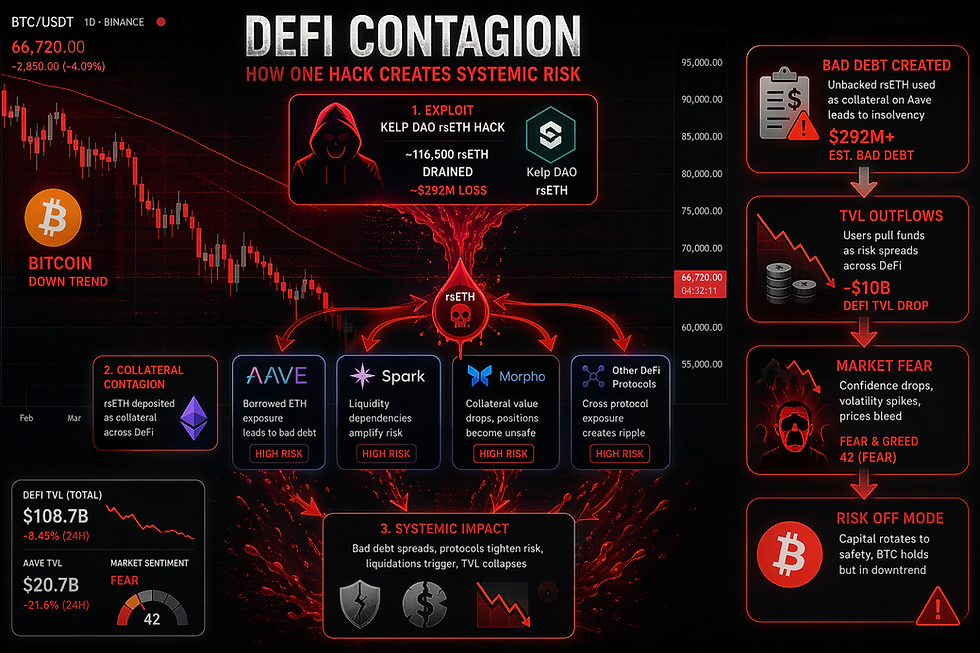
The largest DeFi story right now is still the Kelp DAO rsETH exploit, which was widely reported at roughly $292 million to $293 million in damage after attackers drained around 116,500 unbacked rsETH across multiple chains. That fallout spilled directly into Aave through borrowed ETH exposure and forced emergency response measures.
That is why the immediate systemic threat is not just weak altcoins or bad vibes. It is DeFi contagion risk.
And that matters more than most people realize.
The market still looks BTC-led, not broad risk-on
When I zoom out and look at the weekly structure, the charts are telling a pretty consistent story.
Bitcoin still looks like the strongest major asset in crypto, but the rest of the market has not fully confirmed that it is ready to follow.
That distinction matters.
A lot of traders get chopped up because they assume a Bitcoin bounce automatically means Ethereum is strong, altcoins are ready, and DeFi is safe to press. But that is not what the charts are saying right now.
Bitcoin is stronger than ETH.BTC dominance is still elevated.ETH/BTC has not truly reclaimed trend leadership.TOTAL3 is trying to base, but it has not proven broad alt strength yet.
That is not the profile of a clean altseason breakout. That is the profile of a BTC-first market still trying to stabilize.
Live market data I checked today shows BTC around $74.4K and ETH around $2.28K.
Even though your earlier draft used lower spot numbers, the broader technical thesis still holds up well: BTC is trading inside a key operating range of roughly $65K to $80K, and this middle section is exactly where traders tend to get chewed up if they start forcing conviction too early.
That is why I am still treating this as a range-with-risk, not a clean breakout environment. And at this point its mmore likely we roll over to revist lower levels.
Bitcoin technical analysis: strong relative asset, but still in prove-it territory
On the weekly, Bitcoin is in a better position than Ethereum, but I do not think it is fully out of danger yet.
The key thing I am watching is whether BTC can cleanly reclaim the higher end of this recovery zone and hold it. The chart still looks like a market trying to recover from a hard selloff, not one that has fully repaired itself.
My broader working range remains:
Support zone: roughly $65K
Major resistance zone: roughly $80K
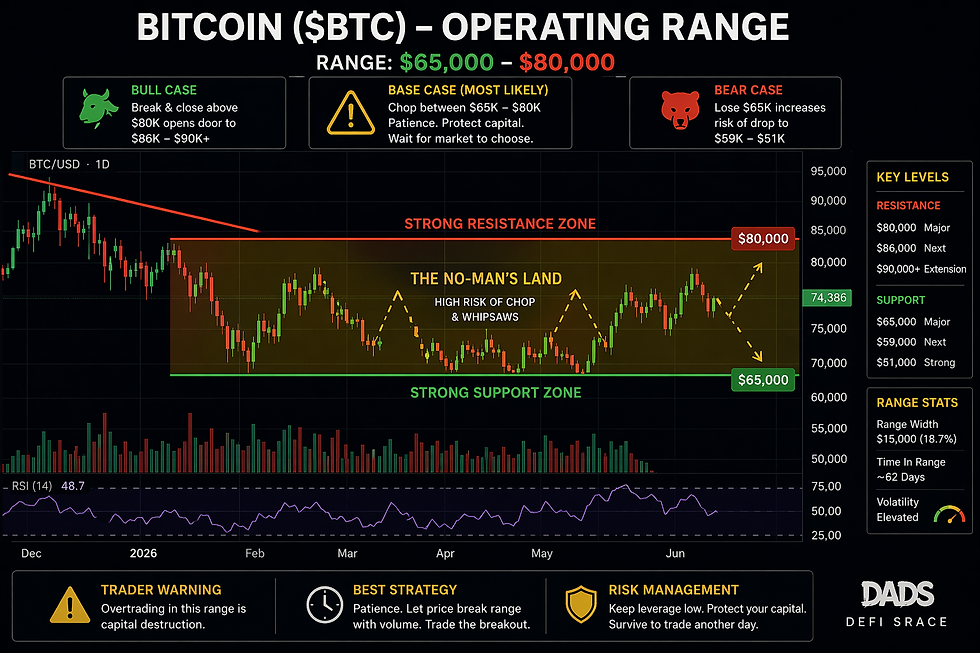
Inside that structure, I am also paying attention to the reclaim area above current price. If BTC can start accepting above that upper reclaim zone, then the bullish case improves a lot. If it cannot, then this still looks more like a relief bounce inside damaged weekly structure.
That is why I am not treating every green candle like proof the market is safe.
The way I think about it is simple: Bitcoin does not need to collapse for traders to lose money. It just needs to keep chopping inside the range while people overtrade the middle.
That is how a lot of people lose slowly.
Ethereum technical analysis: trying to recover, but still weaker than Bitcoin
Ethereum is where the caution matters even more.
ETH has bounced from the lows, but it still looks more like a bottoming attempt than a confirmed trend reversal. The key reclaim zone on the weekly still sits meaningfully above current price, and until ETH can prove itself above that area, I still think it is in “show me” mode.
That is important because ETH usually tells you a lot about whether broader crypto risk appetite is actually improving.
If ETH cannot reclaim leadership, it is hard to make a strong case for aggressive alt exposure.
That is also why the ETH/BTC chart matters so much right now.
In my opinion, ETH/BTC is one of the most important charts in the whole market. It is still structurally weak, still trying to stabilize, and still has not confirmed a real rotation back into Ethereum leadership. As long as that chart stays weak, I think ETH and altcoins remain vulnerable to lagging, even if BTC manages to bounce.
So yes, Ethereum matters. But right now it matters more as a warning sign than as a source of confidence.
BTC dominance and TOTAL3 support the same thesis
This is another reason I am staying cautious.
BTC dominance remains elevated near the high end of its recent structure, which is not what you want to see if you are trying to argue that broad altcoin outperformance has already begun. Usually, real altseason behavior needs Bitcoin dominance to start rolling over in a meaningful way. Right now, that still has not clearly happened.
Then you look at TOTAL3, which is a good way to track altcoin strength excluding BTC and ETH, and the message is similar.
TOTAL3 is trying to form a floor. That part is true. But it still looks like early base-building, not confirmed trend strength. Until it can reclaim the higher parts of that weekly resistance cluster, altcoins remain vulnerable to more rejection, more chop, and more disappointment.
Put all of that together and the chart message is pretty clear:
This is still a BTC-led market trying to stabilize. ETH is still weaker. Alts are still trying to prove themselves. Broad risk-on behavior is still not confirmed.
That is a much different message than what social media usually wants to sell.
The real DeFi story is not price — it is contagion
This is the part I really want people to understand.
The Kelp DAO rsETH exploit was not just another hack headline. It was a reminder that DeFi risk is often layered, not isolated.
Aave was not the original protocol that got hacked. But Aave still got hit because DeFi is built on interconnected collateral, wrapped assets, cross-chain exposure, and shared assumptions. According to Aave governance updates, the Guardian moved to freeze rsETH and wrsETH markets on April 18 once the exploit and downstream exposure became clear.
That is the lesson.
You do not need your favorite protocol to be directly hacked for your position to be affected. You just need it to be connected to the wrong asset or the wrong chain of leverage.
And that is why I keep saying yield quality matters more than headline APY.
A protocol can advertise decent stablecoin yield. A lending venue can look blue-chip. A strategy can feel safe. But if the collateral stack underneath it gets compromised, the whole risk profile changes fast.
This weekend was a textbook example of that.
TVL is dropping because trust is dropping
A lot of newer users look at TVL like it is just a scoreboard.
It is more than that.
TVL is also a rough trust meter.
After the Kelp exploit, Aave reportedly saw TVL fall from around $26.4 billion to roughly $20 billion to $20.7 billion in a single day, while broader DeFi TVL dropped by around $10 billion as users pulled capital out of connected protocols and reassessed exposure.
That matters because capital is voting with its feet.
When TVL drops fast after a hack, it usually means users want less complexity, less hidden dependency risk, and less exposure to collateral they do not fully understand.
That is not just bearish sentiment. That is risk repricing.
And honestly, I think a lot of DeFi users need that reminder. In calmer markets, people get lazy. They start reaching for every extra 2% or 3% yield without asking where it is really coming from. Then one exploit hits, and suddenly everyone remembers why simpler setups often survive better.
Three other recent DeFi hacks traders should not ignore
If you want context for why DeFi confidence feels shaky right now, do not just look at Kelp.
Look at the pattern.
Earlier this month, Drift Protocol was reported as hit by an exploit worth around $285 million, making it one of the largest DeFi incidents of 2026 before the Kelp story took over headlines.
Q1 2026 reporting also tracked about $168.6 million to $169 million stolen across 34 DeFi protocols, with larger incidents including Step Finance, TrueBit, and Resolv Labs.
That is what wears down the market.
Not just one hack. Not just one bad protocol.A pattern of repeated failures that slowly makes users more defensive, more skeptical, and more selective with capital.
And when that happens, TVL drops, altcoins lose narrative strength, and liquidity gets concentrated back into bigger assets like Bitcoin.
Again, same thesis.
What I am personally doing right now
This is where I want to be really honest.
I am not in one of those moods where I want to act like every move I make is some masterclass.
Some weeks are about pressing an edge. Some weeks are about surviving messy conditions, learning from the chaos, and keeping your positioning clean enough to fight another day.
This week was more of the second kind.
After the RAVE mess and the broader DeFi stress, I pulled back on leverage. I kept my focus on larger, deeper-liquidity assets. My Aerodrome LP is mostly cbBTC/USDC right now, and while the yield still looks attractive, I am not blindly trusting emissions to save a weak setup. I am monitoring it closely and will rebalance when the market gives me a better reason to do it.
I still have that smaller Aave position on, and that is part of the point too. I am not writing this like some guy on the sidelines pretending I only ever touch perfect setups. I have exposure. I take risk. I make adjustments. I get reminded, just like everyone else, that diversification and humility still matter.
That is part of why I built DADS DeFi Space the way I did.
I am not here to sell certainty.
I am here to show the process.
Sometimes that means sharing a strong trade idea. Sometimes it means showing where I got too active. Sometimes it means admitting the market is messy and the better move is to scale back, protect capital, and wait.
That is not weakness. That is being an operator instead of a gambler.
Yield and DeFi strategy: where I still see opportunity
Even in messy conditions, there are still places to earn.
You just have to get pickier.
For me, the big shift right now is toward quality over excitement.
That means I care less about the flashiest APY and more about things like:
protocol quality
collateral quality
liquidity depth
systemic risk
whether the yield is real or just emissions dressing up a weak setup
That is also why I still think TAO staking remains one of the more interesting yield refuges in this environment.
Recent reporting said Grayscale increased TAO’s weight in one of its AI-focused crypto baskets to roughly 43.06%, which tells me institutional conviction is still there even while retail sentiment gets shaky.
That does not mean aping into TAO. It means if I am comparing random alt speculation versus a stronger-quality staking or yield setup with actual thesis behind it, I know which one deserves more attention.
That is the difference between structured risk and random exposure.
Scenarios from here
Bull case
The bullish case improves if Bitcoin can reclaim the upper part of its current range and hold it, Ethereum starts proving itself on weekly closes, BTC dominance cools off, and TOTAL3 reclaims more structure. If DeFi panic fades and Aave’s rsETH-related damage gets contained without broader collateral stress, confidence can improve quickly.
Bear case
The bearish case is that Bitcoin rolls over before fully reclaiming structure, Ethereum stays weak, altcoins fail their recovery attempts, and another ugly headline hits DeFi before confidence stabilizes. In that situation, forced unwinds and panic selling can still show up fast.
Base case
My base case is still the messy one:
range-bound price action, fakeouts, fragile sentiment, selective opportunity, and a lot of traders losing money by overtrading the middle.
That is the scenario I respect most right now.
Final thoughts
The biggest mistake people make in markets like this is thinking every bounce deserves aggression.
It does not.
This week was another reminder that crypto can get hit from all directions at once. DeFi exploit risk. TVL outflows. geopolitical noise. macro confusion. altcoin weakness. liquidation cascades. emotional overtrading.
That is why I keep coming back to the same principle:
process over prediction.
You do not need to call every move. You do not need to force every trade. You do not need to pretend conviction is the same thing as discipline.
You need to survive.
You need to protect capital in noisy conditions. You need to understand where the real risk is. You need to stay flexible enough to adapt when the market changes.And you need to remember that the best setup is not always the loudest one.
Right now, the charts still support a cautious, BTC-first thesis. The DeFi backdrop still argues for selectivity. And the middle of this range still looks like a place where impatient traders can do a lot of damage to themselves.
So I am staying grounded.
Less ego.More structure.More patience.Better risk.
That is how I want to play this market.
If you want more breakdowns like this, head over to DADSDeFiSpace.org, join the free Telegram, and follow along on X. I share practical crypto and DeFi education built around process, risk management, and execution — not hype.
For deeper real-time market thoughts, what I’m watching, and how I’m positioning through all this, join the free Telegram.
And if you are looking for exchange perks and private group access, keep an eye on the current offer: 20% deposit bonus | 15% trading fees | private group access.


Comments