


DeFi Concentration Risk: The Aave Exploit Lesson Every Investor Needs to Understand


Have you ever parked money in a DeFi protocol and thought, “This one feels safe enough. I can just leave it here and let it work”?
That is exactly how a lot of people get blindsided.
Not always because the protocol itself blows up. Not always because there was some obvious red flag. Sometimes it happens because something connected to that protocol breaks, liquidity dries up, collateral gets stressed, withdrawals get frozen, or fear starts spreading faster than facts.
That is what makes DeFi dangerous in a different way than many newer investors expect.
The risk is not always loud.
Sometimes the risk is subtle. It hides inside collateral design, ecosystem interdependence, governance decisions, thin liquidity, and the false comfort that comes from using something battle tested. What looks like “safe yield” can turn into a locked withdrawal screen fast when the wrong part of the system breaks.
And that is why this article is not really about dumping on Aave.
It is about something much bigger.
It is about DeFi concentration risk and why too many investors still confuse a strong protocol with a safe portfolio.
That confusion keeps costing people real money.
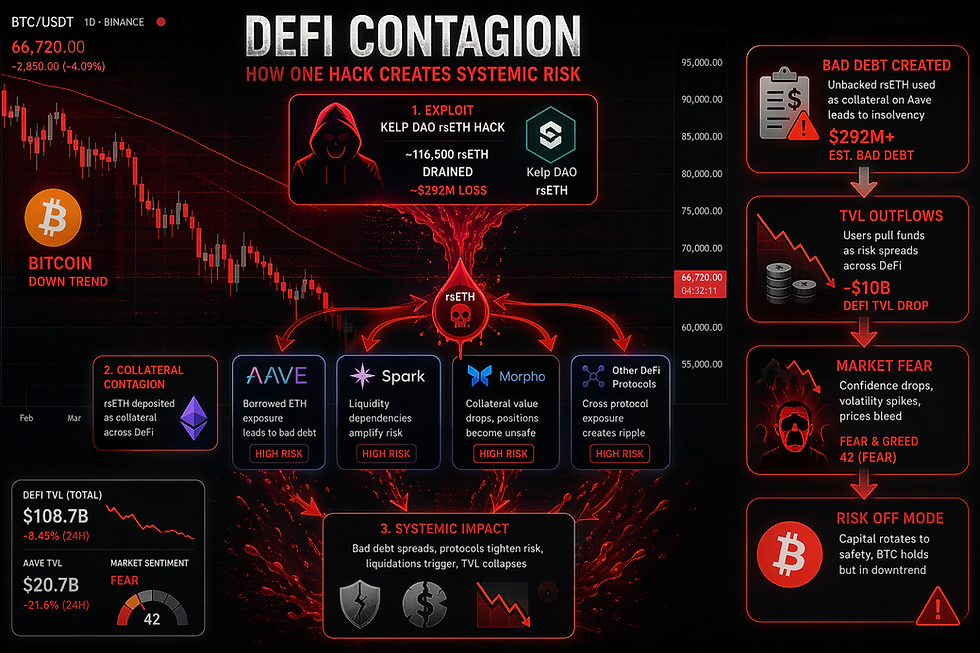
Defi Concentration Risk Aave Exploit
What Happened Around Aave
The key point here is important: Aave should not be treated like some failed clown protocol. In fact, it is still one of the most battle-tested protocols in DeFi. The real concern came from stress tied to assets being used inside the system, not simply from the protocol itself being “hacked” in the way people on social media often frame things.
That distinction matters.
A lot of people hear a headline, see funds frozen, see TVL dropping, and immediately reduce the story to one sentence. Usually the wrong one.
But DeFi is rarely that simple.
What actually matters is this:
a protocol can be well known and still face stress
your position can be affected even when the protocol itself was not directly exploited
collateral issues can spread fear across lenders, borrowers, and liquidity providers
the market often discovers hidden risk only after confidence starts slipping
And that is the real teaching moment here.
You do not need to have your entire portfolio inside a failing protocol to learn from a stress event. Sometimes a small position is enough to remind you how fast “comfortable” can become “complicated.”
Safe DeFi Is Not the Same as Risk-Free DeFi
This is where a lot of newer DeFi users get tripped up.
They think risk only counts if one of these things happens:
the smart contract gets drained
the team rugs
a wallet gets exploited
a stablecoin depegs overnight
Those are real risks, of course.
But they are not the only risks.
The risk can be a liquidity issue, a governance issue, a cascading failure, or some indirect collateral problem that creates pressure across the protocol anyway. In other words, funds can still be at risk because of what is happening around the protocol, not only what is happening inside the protocol.
That is one of the hardest DeFi lessons to learn early.
A protocol can be strong.
A position inside that protocol can still be fragile.
Those are not contradictory statements.
That is why I keep coming back to the same framework: process over prediction.
You do not need to guess every exploit ahead of time.
You do need a system that assumes things can go wrong in ways you did not expect.
Understanding DeFi Contagion
One of the biggest things investors need to understand is that DeFi is interconnected.
That is not just a buzzword. It is the whole game.
Protocols borrow trust from each other.
Assets move across multiple layers.
Collateral gets rehypothecated.

Yield often depends on incentives, liquidity, leverage, and market confidence all working at the same time.
So when one part of the system breaks, the damage does not always stay where it started.
That is contagion.
One piece of the system breaks, and it can ripple across everything.
That is why smart DeFi investors need to separate three different kinds of risk:
1. Direct protocol risk
This is the obvious one. Smart contract bug. Governance exploit. Team failure. Oracle failure.
2. Asset risk
This is when the token or collateral itself becomes the problem. Maybe liquidity disappears. Maybe volatility spikes. Maybe some restaking or wrapped asset assumption breaks.
3. Systemic or contagion risk
This is the part many people underestimate. The protocol you use may still function technically, but exposure elsewhere in the stack can still hit your funds, your collateral flexibility, your exit liquidity, or your confidence in staying positioned.
That is why “Aave is trusted” is not enough by itself.
The better question is:
What exactly am I exposed to through this position, and what happens if one layer below it starts failing?
That question will save people a lot more money than chasing whichever protocol is being called “safe” on X that week.
The Real Portfolio Killer: Concentration
Here is the real heart of the article.
Most people are not losing money in DeFi only because of hacks. They are losing money because of concentration. They go all in on one protocol, one chain, one token, or one strategy and then act shocked when one weak point becomes a portfolio-level event.
That is the real killer.
Not risk itself.
Concentration.
Let’s define it simply.
DeFi concentration risk means too much of your portfolio depends on one thing continuing to work.
That one thing could be:
one lending protocol
one yield farm
one bridge
one chain
one stablecoin
one restaked asset
one narrative
one LP strategy
one collateral type
This is where people fool themselves.
They think they are diversified because they have multiple positions.
But if all those positions depend on the same chain, the same collateral type, or the same ecosystem liquidity, they are not diversified.
They are concentrated in disguise.
That is why survivability matters so much more than looking smart in the short term.
A strong process asks:
What happens if this protocol freezes activity?
What happens if this collateral loses market trust?
What happens if exits get crowded?
What happens if I am right on the long-term thesis but wrong on the timing?
What happens if this all gets messy on a Sunday night when liquidity is thin?
If one bad answer can wreck the portfolio, the structure is too fragile.
Historical DeFi Lessons Investors Keep Ignoring
People always act like the latest failure is some one-off weird event.
Usually it is not.
The names change. The pattern does not.
A few major examples make that clear:
Terra Luna
Ronin Bridge
Wormhole
Drift-related security concerns and the human attack vector
The details differ, but the repeated lesson is the same: people trusted one system with too much capital, or trusted one part of the stack without thinking through second-order risk.
Terra Luna
This one still matters because it showed that something does not need to be “hacked” in the classic sense to completely destroy capital. Bad design, reflexive incentives, and false confidence can do enough damage on their own.
Ronin Bridge
This was a reminder that bridge infrastructure can be an enormous attack surface. A lot of users thought they were simply participating in an ecosystem they liked. Under the surface, they were taking on much more security risk than they realized.
Wormhole
Another reminder that cross-chain convenience often comes with serious trust assumptions. Cross-chain systems are useful, but they are not magic. Every layer adds another potential failure point.
Drift and human risk
One of the most important points here is that not all failure starts in code. Social engineering, poor security practices, and human mistakes can hit strong systems too. That matters because many investors focus so much on protocol quality that they ignore operator risk.
Different stories.
Same lesson.
Do not build a portfolio that assumes one thing cannot fail.

How I Think About DeFi Risk Management
This is where the article needs to shift from fear to framework.
Because the goal is not to scare people out of DeFi.
DeFi is powerful. It is innovative. It still matters. But if you want to play this game for years instead of months, your job is not to avoid all risk. Your job is to avoid the kind of mistake that wipes you out.
Here is the practical framework.
1. Do not keep all your funds in one protocol
This sounds basic, but people still mess it up constantly.
Even if a protocol is blue chip, size it like it can still become inconvenient, illiquid, or stressed.
2. Spread exposure across different chains when it makes sense
Chain diversification is not perfect, but it helps reduce the odds that one ecosystem event becomes a total portfolio event.
3. Avoid overexposure to one token or collateral type
You are not diversified if three different protocols all depend on the same fragile asset.
4. Keep some assets off DeFi entirely
Some assets should just stay in cold storage. Everything does not need to be productive all the time. Dry powder and simple custody are positions too.
5. Position size matters more than confidence
You can like a protocol and still keep the size appropriate.
That is not bearish.
That is adult risk management.
6. Ask the family test question
This is one of the best filters you can use:
If this money disappears tomorrow, will me and my family still be okay?
That question cuts through noise fast.
If the honest answer is no, the position is too big, too fragile, or too emotional.
A Simple DeFi Risk Framework for Regular Investors
Here is a cleaner checklist version you can use.
Before entering a protocol
What is the actual source of yield?
What asset am I really exposed to?
How deep is the liquidity?
What are the smart contract and collateral risks?
Is this yield coming from real demand, token emissions, leverage, or narrative heat?
What is my exit plan if the structure weakens?
While managing the position
Has liquidity changed?
Has collateral quality changed?
Has the market narrative shifted?
Has usage dropped or stress increased?
Am I staying because the thesis is intact, or because I do not want to admit risk increased?
When risk starts rising
Cut size before panic becomes forced action
Avoid emotional doubling down
Move part of the position back to stables or cold storage
Review whether the original thesis still exists
Respect second-order risk, not just direct protocol headlines
That is what execution looks like.
It is not glamorous.
But neither is recovering from a wipeout.
What People Get Wrong About Yield and Safety
A lot of investors still treat yield like a shortcut to safety.
They think:
if the protocol is popular, it must be safe
if the APY is stable, the structure must be fine
if big names use it, the tail risk must be manageable
if it has not broken yet, it probably will not
That is lazy thinking.
Yield can be good.
DeFi can absolutely be worth using.
But headline APY is not the same thing as yield quality.
And trust is not a substitute for process.
In practice, that means:
understand what you own
understand why it pays
understand what breaks it
understand where liquidity comes from
understand how fast you can leave if conditions change
The exit matters too.
It always does.
Final Takeaway
The lesson here is not “never use Aave.”
The lesson is not “DeFi is dead.”
And the lesson is definitely not “just avoid risk completely.”
The lesson is this:
Even good protocols exist inside messy systems.
That means your portfolio cannot rely on trust alone.
If you want to survive in DeFi, you need structure.
You need to think in layers.
You need to assume that hidden exposure exists.
And above all, you need to avoid concentration that turns one protocol problem into a personal financial problem.
That is what process over prediction looks like in the real world.
Not pretending you can forecast every event.
Building in enough discipline that one event does not take you out of the game.
FAQ Section
What is DeFi concentration risk?
DeFi concentration risk is when too much of your capital depends on one protocol, one chain, one collateral type, or one strategy continuing to work. If that single point fails, your portfolio can take an outsized hit.
Can a DeFi protocol be safe and still be risky to use?
Yes. A protocol can be battle tested and still expose you to indirect risks through collateral quality, ecosystem stress, liquidity problems, or contagion from connected protocols.
Did Aave itself get hacked in this example?
The bigger lesson is not simply whether Aave itself failed in a direct way. The real point is that stress around assets and interconnected exposure can still create real risk for users.
Why is diversification important in DeFi?
Diversification helps reduce the odds that one exploit, one governance issue, one bridge failure, or one collateral problem wipes out a large share of your portfolio.
Should I keep all of my crypto in DeFi?
Probably not. Some assets are better kept in cold storage, especially if your goal is long-term survivability and not maximum exposure at all times.
Are bridges still one of the biggest risks in crypto?
They have historically been a major risk area because they add complexity and additional trust assumptions. Bridge failures have shown how costly those risks can become.
What is the best way to reduce DeFi risk?
A good starting point is to spread exposure across protocols and chains, reduce dependence on one token or one ecosystem, keep position sizes reasonable, and maintain some capital outside DeFi entirely.
What question should I ask before entering a risky DeFi position?
A strong filter is: if this money disappears tomorrow, will I and my family still be okay? If the answer is no, the position is probably too large or too fragile.
Conclusion
DeFi is still one of the most powerful parts of crypto.
It gives people access to lending, borrowing, liquidity, yield, and market structure in ways traditional finance still struggles to match. But none of that changes the reality that this space is experimental, interconnected, and sometimes brutally unforgiving.
That is why I do not think the right lesson is fear.
I think the right lesson is structure.
A better process.Better sizing.Better diversification.Better awareness of hidden exposure.Better respect for the fact that one “safe” position can still carry unsafe second-order risk.
That is the game.
Not predicting every failure.
Building a system that lets you survive them.
Process over prediction. Every time.
DADS DeFi Space
If you want more breakdowns like this, head over to DADSDeFiSpace.org and join the free Telegram. I share practical crypto and DeFi education focused on process, risk management, and execution — not hype. That is where I break down what I’m watching, how I’m thinking through risk, and the bigger framework behind the moves.
You can also check out the free course if you are trying to understand DeFi with a stronger foundation and fewer expensive mistakes.
Website: https://www.dadsdefispace.orgFree
Telegram: https://t.me/DADSDefiSpaceFree Course: https://www.dadsdefispace.org/challengesX: https://x.com/cryptozone1013


Comments